
Educational Pack · 01
Commodities
Source PDF: GUIDE-TO-UNDERSTANDING-ASSET-CLASSES-COMMODITIES.pdf
U Wealth : Your partner in mastering financial instruments. We want you to feel comfortable making suitable investment decisions based on knowledge of the opportunities and risks of given financial instruments. — September 2026
What are commodities?
A commodity is a marketable item or good produced. In economics, this includes all goods and services.
In finance, to be traded as a 'commodity', the goods must be:
- sufficiently standardised (same quality for the same good) and usable upon delivery
- traded in bulk
- have price variations big enough to be attractive for investors
Examples include:
- energy: crude oil, gas
- base metals: copper
- precious metals: gold
- agriculture: wheat
- livestock: cattle
- bulks: e.g. iron ore, coal
Advantages / Disadvantages
Advantages
- Diversification: commodities respond differently to economic movements than stocks and bonds
- Protection against inflation
Disadvantages
- Cost of carrying fees (storage fees for physical reserves)
- Bid/ask spread
- Volatility
If used as a financial investment, commodities other than precious metals are usually not bought/sold directly; instead, one invests in products that have commodities as underlying assets. There are a variety of financial instruments available, such as structured products, derivatives, and mutual funds.
Such instruments bear other opportunities and risks, and investing in them requires the corresponding knowledge. Please consult the relevant U Wealth educational material for details on these instruments.
Important risks to consider
Market risks
- Commodities are highly volatile in price and depend on many factors other than supply/demand including geopolitical situation, country-specific economic factors, inflation, natural influences (e.g. climate, weather) and the nature of the commodity itself.
- Commodities respond differently to economic cycles than financial instruments like stocks and bonds.
Indirect investments
- Unless investors are interested in the goods themselves, they usually invest indirectly, using financial instruments such as futures and options that have commodities as underlying assets.
- Investors who forget to close a long position of a future before expiry will receive physical delivery of the commodity.
What to expect from commodities
Investment horizon
- Short term
- Medium term
- Long term
Income expectation
- Capital gain
Market expectation
- Increasing
- Decreasing
- Sideways
- High volatility
Important to know before investing in commodities
Maximum gain
Unlimited: any capital gain realised minus bid/ask spread.
Maximum loss
Total loss of capital invested.
Profit/loss
Revenues on commodities are difficult to estimate. In making your investment decisions, consider the following points:
- the market value of commodities responds differently to changes in the global economic environment and traditional instruments. This can be an advantage as much as a risk.
- commodities are more volatile than other financial instruments. Being physical goods and basically raw materials, they are often directly linked to regional or global industrial supply/demand.
- investing in commodities that have collective value and prices, such as coins or gemstones, can lead to price volatility and subjective valuation.
- the supply/demand equality of the commodity may be an issue.
- if physical commodities must be safely and correctly stored.
How commodities work
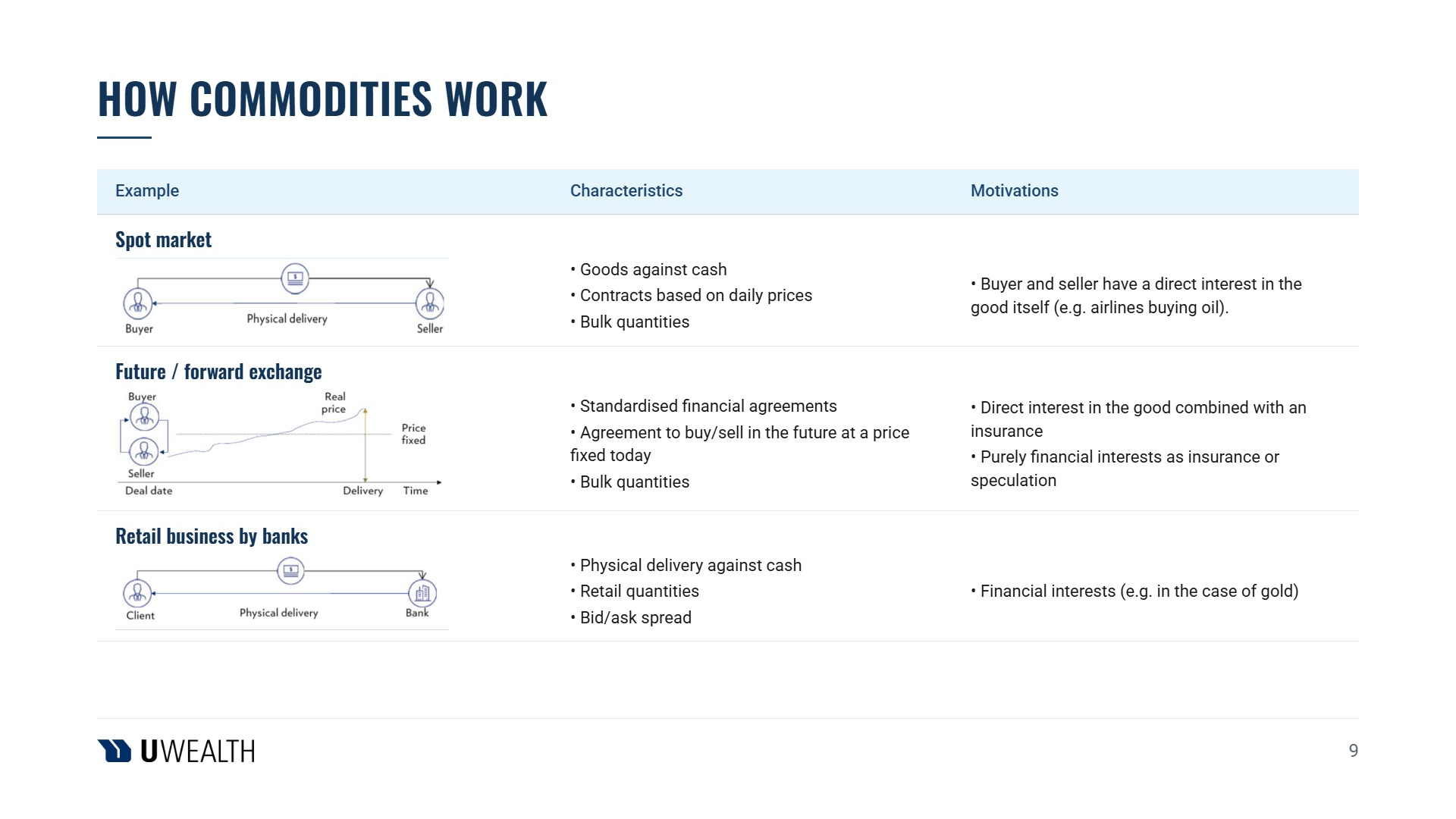
| Example | Characteristics | Motivations |
|---|---|---|
| Spot market — Buyer and Seller exchange goods for physical delivery | Goods against cash · Contracts based on daily prices · Bulk quantities | Buyer and seller have a direct interest in the good itself (e.g. airlines buying oil). |
| Future / forward exchange — Buyer and Seller agree on a price for future delivery | Standardised financial agreements · Agreement to buy/sell in the future at a price fixed today · Bulk quantities | Direct interest in the good combined with an insurance · Purely financial interests as insurance or speculation |
| Retail business by banks — Client and Bank exchange goods for physical delivery | Physical delivery against cash · Retail quantities · Bid/ask spread | Financial interests (e.g. in the case of gold) |
Direct and indirect trading of commodities
For investors who have no interest in trading the physical good itself, there are two options for trading commodities.
Indirect — trading a financial product that has a commodity as an underlying
- Futures, forwards, options, and structured products: these are advanced financial instruments with very specific properties and risks. Investing in these instruments requires the corresponding knowledge. Please consult the relevant U Wealth educational material on these instruments.
- Mutual funds: funds are collective investments that pool money from a number of clients for common investment. Funds are available for any type of investment. Risks and properties vary and a basic knowledge of funds is required.
Direct — buying and selling precious metals
- Precious metal account: this is similar to holding foreign currencies.
- Physical delivery: buying and selling the physical items, e.g. bars, coins. In order to protect the investor, they are usually kept in custody with a bank and custody fees apply.
Commodity indices
When investing indirectly in commodities, corresponding products (e.g. funds) are often based on commodity indices or commodity futures due to their advantages regarding accessibility and traceability.
There are a number of available indices that track the commodity markets. These indices differ in their composition (component weights) and roll strategies.
Composition and component weights
Determination of which components (e.g. agriculture, oil, wheat) are included in the index, and in what ratio. For example, a product based on the index may be used to reflect trends towards production economies and liquidity.
Roll strategies
The investment strategies do not track commodity spot prices directly but rather future prices. Futures are shorter-term investments that are rolled over when the investment term ends. Upon rollover, there are costs and gains. The roll strategy determines which investment terms and costs are calculated in the index.
Main risks associated with commodity investments
When you invest in commodities, you are usually exposed to two categories of risk.
Commodity market risk
- Commodity prices are highly volatile.
- The reasons for changes in commodity prices are not always clear to investors.
- Commodities are not equally distributed globally; instead, different commodities are found in different regions and countries. Inflation, etc. carry different risks, e.g. agricultural goods are exposed to adverse climatic conditions. Therefore, commodity prices are not merely a function of supply and demand. They are also a function of natural, geopolitical, country-specific, and economic factors.
- Commodities are the basis for other products, and they respond differently to the economic cycle and to other financial instruments (e.g. stocks and bonds).
Financial product risk
- Private investors do not stand to directly receive commodities.
- Investments therefore carry specific risks and rewards of the financial product chosen, e.g. structured product or derivative. Such investments can also offer diversification of the commodity market risks, as well as adding new risks through the mechanics of the product itself.
- Investments are made in a financial form, the risks are those of the risks carried by the product plus any risk that the index may carry (e.g. a tracking error).
- Investors who forget to close a long position of a future before expiry will receive physical delivery of the commodity (if they have not agreed on cash settlement only).
Important legal information
U Wealth SA – 8C avenue de Champel, 1206 Genève, Suisse. Supervised by FINMA (Swiss Financial Market Supervisory Authority). This content is provided for informational and educational purposes only. It does not constitute marketing material, nor is it the result of independent financial/investment research. It has not been prepared in accordance with the legal requirements designed to promote the independence of financial research and is not subject to any prohibition on dealing ahead of the dissemination of such research.
Informational purposes only
All information and opinions were valid at the time of writing and are subject to change without notice. This document is provided for informational purposes only and does not constitute legal, tax, accounting or investment advice, nor does it constitute an offer or invitation to buy or sell any financial instrument. Opinions expressed herein reflect the current views of the authors but not necessarily those of U Wealth SA as a whole. While the information is believed to be accurate and sourced from reliable providers, U Wealth SA makes no warranty as to its accuracy, completeness, or timeliness. U Wealth SA accepts no liability, to the extent permitted by law, for any direct or indirect damages or losses arising from the use of this material or any decisions taken based on it.
Suitability & professional advice
Investments mentioned may not be suitable for all investors. Each investor should consider the suitability of an investment to their personal circumstances and objectives and consult their professional advisor before making any financial decision. This content does not constitute a personal recommendation and does not take into account your personal investment profile or financial situation.
Sustainability / ESG
This material does not necessarily adhere to ESG regulations or standards that may apply in other jurisdictions. For details on ESG criteria and any potential impact on financial return or investment eligibility, please contact U Wealth directly.
General risks
The value of and income from investments may rise or fall, and investors may not recover the amount invested. Financial instruments may be exposed to various risks, including but not limited to market, credit, political, and currency risks. Past performance and simulated returns are not reliable indicators of future performance. Structured products mentioned do not represent collective investment schemes under Swiss law and are not supervised by FINMA as such. Investors do not benefit from the specific protections provided by the Swiss Federal Act on Collective Investment Schemes.
Third-party data
Some information may originate from third-party providers such as credit rating agencies, financial data sources, or ESG data platforms. U Wealth SA does not guarantee the accuracy or completeness of this data and declines any liability related to its use.
Restricted distribution
This content is intended solely for recipients located in Switzerland and is not directed to any person or entity in any jurisdiction where its distribution would be contrary to local laws or regulations. This document may not be reproduced or distributed without prior written consent from U Wealth SA. UNITED STATES: NEITHER THIS CONTENT NOR ANY COPY THEREOF MAY BE SENT, TAKEN INTO OR DISTRIBUTED IN THE UNITED STATES OR TO ANY US PERSON. © U Wealth, 2025
Contact information
contact@uwealth.ch | +41 (0)22 545 51 40