
Educational Pack · 16
Private Equity
Source PDF: GUIDE-TO-UNDERSTANDING-ASSET-CLASSES-PRIVATE-EQUITY.pdf
U Wealth : Your partner in mastering financial instruments. We want you to feel comfortable making suitable investment decisions based on knowledge of the opportunities and risks of given financial instruments. — September 2026
What is private equity?
Private equity is an individual asset class.
Private equity is participation capital in companies that are generally not listed on the stock market (hence 'private', not public). Participation ranges from early stage financing to management buyouts.
Private equity is an alternative investment that does not correlate closely with traditional investments. Apart from providing returns, it can contribute to the diversification of a portfolio.
Private equity funds are investment partnerships that only accept professional, institutional, or qualified investors.
Advantages / disadvantages
Advantages
- Participation in markets not available through traditional financial instruments
- Participation in market environments where traditional instruments offer few opportunities
- Professional management with performance incentive
- Reduced portfolio volatility
- Opportunities for high returns at the expense of long-term investments
Disadvantages
- Liquidity constraints: minimum investment period (lock-up periods); not usually listed; illiquid participation
- Predictability: capital drawdowns on the investment amount (i.e. requests for a payment by the investor to the fund) and the cash flow of the return are not determinable beforehand.
- Only accessible to professional, institutional, accredited, or qualified investors
- Lack of control: the quality of fund management is crucial to the success of the fund.
Important risks to consider
Private equity and private equity funds
| Risk | Description |
|---|---|
| Accessibility | Only accessible to professional, institutional, accredited, qualified investors |
| Liquidity risks | Private equity cannot usually be sold, and so, if at all, can only be liquidated. |
| Market risks | Private equity is a market as other return investments dependent on the market environment. However, some dependencies remain: the economic success of a company also depends on the general economic environment. With investments, and the timing of the investments, a favorable economic condition on the public market influences the cash flow with investors. |
| Predictability | Cash flows (drawdowns) as well as payouts are not predictable. Conditions are not, at the time of investment, fully dependent on the quality of the management. |
| Valuation | When investing directly in private equity, the valuation of the investment may be difficult. |
| Operational risks | The quality and expertise of the fund management and staff are crucial to the success of the fund investment. |
| Long-term investment | The capital is tied down for an average period of four-to-six years. |
| Legal and regulatory risks | The participation in this type of investment vehicles may be restricted by local legislation and may influence the taxation of the investment. |
What to expect from private equity
| Investment horizon | Income expectation | Market expectation |
|---|---|---|
| Long term | Capital gain; irregular dividends | Independent |
Important to know before investing in private equity
| Maximum gain | Maximum loss |
|---|---|
| No strict preconditions – fund managers aim at maximum return | Total loss of capital invested |
Profit/loss
- Possible profits cannot be predicted; the fund strives to return objective.
- A longer-term investment horizon is required; possibly with the option of earlier termination or sale.
- Profit/loss and risks involved also depend on the quality of the management.
- Private equity investments can take place in different phases of company development.
- Due to their investment strategies, private equity instruments are more independent, i.e. less exposed to individual movements on stock and bond markets.
- They are an alternative investment used for diversification and income optimisation.
A closer look at private equity
Types of private equity investments (1/3) — Three potential investment types
| Direct investment | Private equity fund investment | Private equity fund of funds investment |
|---|---|---|
| Open to holding through a direct equity stake in a company by an individual investor. May not be feasible or interesting for an individual investor due to the high associated effort, substantial minimum capital investment, specialist knowledge required, as well as the risk of default. | Aims for substantial control or even company ownership. Collect capital from investors and invest in a small number of companies (usually 10-20). Companies are optimised in value by restructuring and/or organisational improvements. While earning ensuring ownership, the returns achieved by public listing or resale of the company. | Investment in a small number of individual private equity funds. Enables diversification of the risks across a larger number of companies, sectors, and countries. |
Types of private equity investments (2/3) — Subdivisions of private equity
Private equity can be subdivided into four broad categories according to the development phase of the company the investment is targeted at.
| Category | Description |
|---|---|
| Venture capital | Investment in young growth companies, supporting development of business ideas and products, the marketing and sale of new products, as well as the expansion of business and growth of the market share. The companies profit from financing as well as from the know-how the investors provide. |
| Growth Capital | Growth capital typically involves minority investment in mature companies that are looking for capital to expand or restructure operations, finance a major acquisition, or enter new markets. Companies involved in growth capital typically can generate revenue and operating profits but cannot generate enough cash to fund major expansions, acquisitions, or other investments. |
| Buyout Capital | Investment in mature companies with the aim of taking them over, supporting their expansion and growth, or facilitating a turnaround for positive performance. Less risky than venture capital. |
| Distress & special situations | This is a broad category that refers to investments in the equity or debt securities of financially stressed companies. This sector has grown in importance over recent years, as banks have pulled back from such rescue lending situations, mainly due to regulatory changes. |
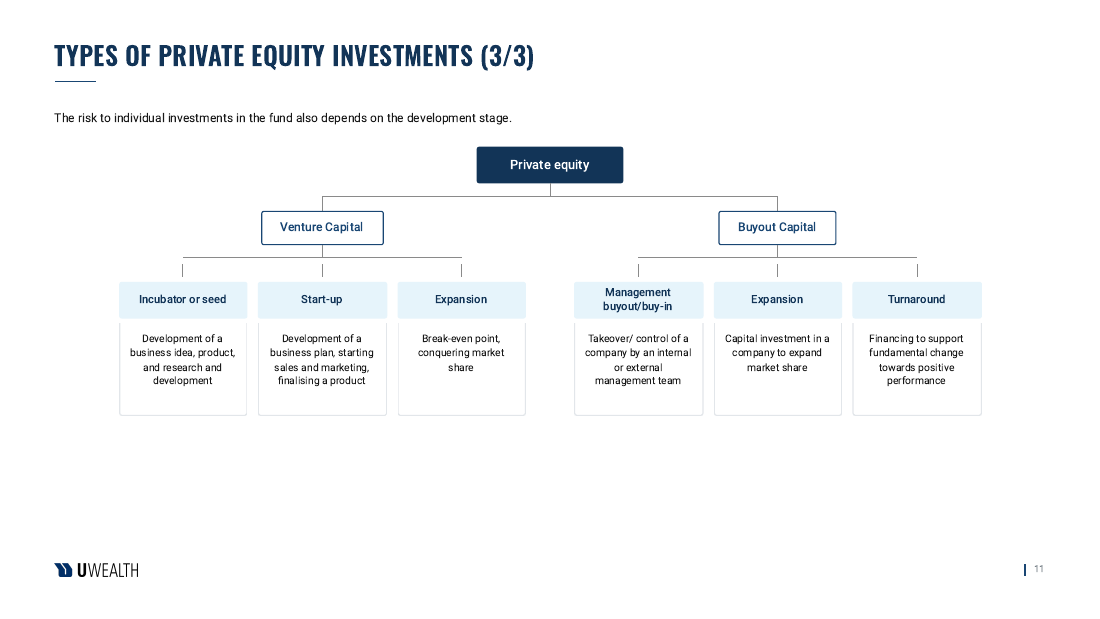
Types of private equity investments (3/3)
The risk to individual investments in the fund also depends on the development stage.
Properties of private equity funds
Private equity funds are long-term investments with special characteristics
- The term of a fund is usually restricted to about 10-12 years.
- The fund is closed after an initial subscription period of 3-18 months.
- Investments are characterised by high minimum amounts of EUR 5-25 million for medium- to large-scale funds.
- Capital is invested from three to six years and withdrawn in tranches. The full amount is not usually drawn at any one time.
- Repayment and returns commence at about four-to-seven years into the investment.
- Investment objectives vary, but the goal is to obtain a maximum return on the investment.
- It is not usually possible to liquidate or terminate the investment early.
- Fund managers are generally investment partners themselves whose major incentive is sharing the profits.
Important legal information
Legal entity
U Wealth SA – 8C avenue de Champel, 1206 Genève, Suisse. Supervised by FINMA (Swiss Financial Market Supervisory Authority).
Educational and Informational Disclaimer
Educational and Informational Disclaimer: This content is provided for informational and educational purposes only. It does not constitute marketing material, nor is it the result of independent financial/investment research. It has not been prepared in accordance with the legal requirements designed to promote the independence of financial research and is not subject to any prohibition on dealing ahead of the dissemination of such research. The content has been prepared by U Wealth SA, which is authorised and regulated by FINMA (Swiss Financial Market Supervisory Authority). The information may be updated irregularly or in response to significant developments.
Informational Purposes Only
Informational Purposes Only: All information and opinions were valid at the time of writing and are subject to change without notice. This document is provided for informational purposes only and does not constitute legal, tax, accounting or investment advice, nor does it constitute an offer or invitation to buy or sell any financial instrument. Opinions expressed herein reflect the current views of the authors but not necessarily those of U Wealth SA as a whole. While the information is believed to be accurate and sourced from reliable providers, U Wealth SA makes no warranty as to its accuracy, completeness, or timeliness. U Wealth SA accepts no liability, to the extent permitted by law, for any direct or indirect damages or losses arising from the use of this material or any decisions taken based on it.
Suitability & Professional Advice
Suitability & Professional Advice: Investments mentioned may not be suitable for all investors. Each investor should consider the suitability of an investment to their personal circumstances and objectives and consult their professional advisor before making any financial decision. This content does not constitute a personal recommendation and does not take into account your personal investment profile or financial situation.
Sustainability / ESG
Sustainability / ESG: This material does not necessarily adhere to ESG regulations or standards that may apply in other jurisdictions. For details on ESG criteria and any potential impact on financial return or investment eligibility, please contact U Wealth directly.
General Risks
General Risks: The value of and income from investments may rise or fall, and investors may not recover the amount invested. Financial instruments may be exposed to various risks, including but not limited to market, credit, political, and currency risks. Past performance and simulated returns are not reliable indicators of future performance. Structured products mentioned do not represent collective investment schemes under Swiss law and are not supervised by FINMA as such. Investors do not benefit from the specific protections provided by the Swiss Federal Act on Collective Investment Schemes.
Third-Party Data
Third-Party Data: Some information may originate from third-party providers such as credit rating agencies, financial data sources, or ESG data platforms. U Wealth SA does not guarantee the accuracy or completeness of this data and declines any liability related to its use.
Restricted Distribution
Restricted Distribution: This content is intended solely for recipients located in Switzerland and is not directed to any person or entity in any jurisdiction where its distribution would be contrary to local laws or regulations. This document may not be reproduced or distributed without prior written consent from U Wealth SA.
United States
UNITED STATES: NEITHER THIS CONTENT NOR ANY COPY THEREOF MAY BE SENT, TAKEN INTO OR DISTRIBUTED IN THE UNITED STATES OR TO ANY US PERSON. © U Wealth, 2025
Contact information
contact@uwealth.ch | +41 (0)22 545 51 40