
Educational Pack · 03
Digital Assets
Source PDF: GUIDE-TO-UNDERSTANDING-ASSET-CLASSES-DIGITAL-ASSETS.pdf
U Wealth : Your partner in mastering financial instruments. We want you to feel comfortable making suitable investment decisions based on knowledge of the opportunities and risks of given financial instruments. — September 2026
What are digital assets?
Digital assets are assets based directly or indirectly on a blockchain or another digital, distributed, and encryption-based ledger or similar technology.
Blockchain is a decentralised ledger of all transactions across a peer-to-peer network enabling multiple users to maintain their copy of the shared ledger. They are cryptographically secured using mathematical algorithms to regulate the creation of new units (tokens) and to verify the legally binding transfer of values/funds.
Despite the commonly used designation 'cryptocurrency', it is questionable whether the commonly accepted requirements of a currency (e.g. medium of payment, unit of account, and store of value) are met because of the high volatility, transaction costs, and current level of adoption.
Digital assets are neither supervised nor controlled by a central authority and operate independently of banks; ownership and transaction-related information are stored in digital public ledgers. Digital assets of all kinds can be issued with relatively little effort; as of November 2021, more than 14,000 of them are known (source: coinmarketcap.com).
Advantages / Disadvantages
Advantages
- Direct participation in a new asset class
- Participation in companies or projects that are not available via traditional financial instruments
- Participation in market environments where traditional instruments offer few opportunities
- Transformation of non-bankable assets into bankable, transferable, and tradeable assets
- Diversification benefits (which have been observed to a certain extent over medium to long term)
- Opportunities for high returns via high-risk investment instruments
Disadvantages
- Pricing and forecasting of digital assets is very complex due to the still low adoption rate, network effects, the interaction of speculators and the evolving regulatory environment, the growing influence of central banks, governments, and national and supranational regulatory authorities, and the incentives of other market participants (e.g. miners).
- Possible liquidity constraints: only some marketplaces for digital assets operate in a regulated environment.
- High volatility: digital assets are subject to sudden price changes and their cause is not always clear to the investor.
- Predictability: past performance is no reliable indicator of future returns.
- Brokerage and custody costs: the brokerage and custody costs decrease the return from the investment.
Important risks to consider (I)
General risks associated with digital assets
- Access and use of the services and infrastructure provided at own risk
- The risk of loss in holding and/or trading digital assets can be substantial
Risks associated with the trading of digital assets
- Trading and execution risks
- Market risks including, but not limited to, liquidity and volatility risks
- Internet transmission risks
- Transaction delay risks
- Wallet transfer risk
- Settlement risks
Risks associated with the storage/custody of digital assets in general
- Risk of losing access to digital assets
- Risk of unauthorized access
- Risk of hacking or any sort of cybercrime
- Risks associated with potential lack of segregation of digital assets
- Risk of technical problems or operational mistakes
Important risks to consider (II)
Risks associated with regulation
- Legal and regulatory risks in general including, but not limited to, financial crime, market abuse, investment and product-related risks
- Default and insolvency risks of market participants
- Lack of supervision and lack of a central regulatory authority
- Risk of seizure of digital assets and sanctions
- Risk of digital assets being considered 'tainted' (e.g., because of interaction or exposure with addresses seen as linked to criminal activity)
- Risks associated with regulation-driven trading bans or investment restrictions
- Risk associated with specific types of digital assets
Risks associated with the underlying technology
- Risks of digital assets existing on a distributed ledger only
- Risks relating to the technologies employed
- Risk of weaknesses in the field of cryptography
- Fork risks and risks of similar events
- Risks associated with consensus mechanism
- Risks of immature technology, e.g. software bugs and exploits/hacks
Important risks to consider (III)
Risks associated with market conduct
- Insider dealings, e.g., pump and dump
- Induced transactions through disclosure of misleading information
- Other forms of market manipulation, e.g. front running, wash trading, or stop-loss hunting
- Risk of exploitation of weaknesses of on-chain governance mechanisms (e.g., in 'DAOs')
Risks associated with financial crime
- Investment fraud, e.g. fraudulent capital raising with ICOs or Ponzi schemes
- Fraud through 'rug pulls' (theft or misappropriation of digital assets by way of undocumented software features and/or collusion)
- Money laundering and Terrorist financing
What to expect from digital assets
Investment horizon
- Short term
- Medium term
- Longer term
Income expectation
- Capital gain
Market expectation
- Independent
- High volatility
- Increasing
Important to know before investing in digital assets
| Maximum gain | Maximum loss | Profit/loss |
|---|---|---|
| No predictions | Total loss of capital invested | Possible profits cannot be predicted in terms of volume and time. Long only – in general, no short selling possible for digital assets |
How does a blockchain work?
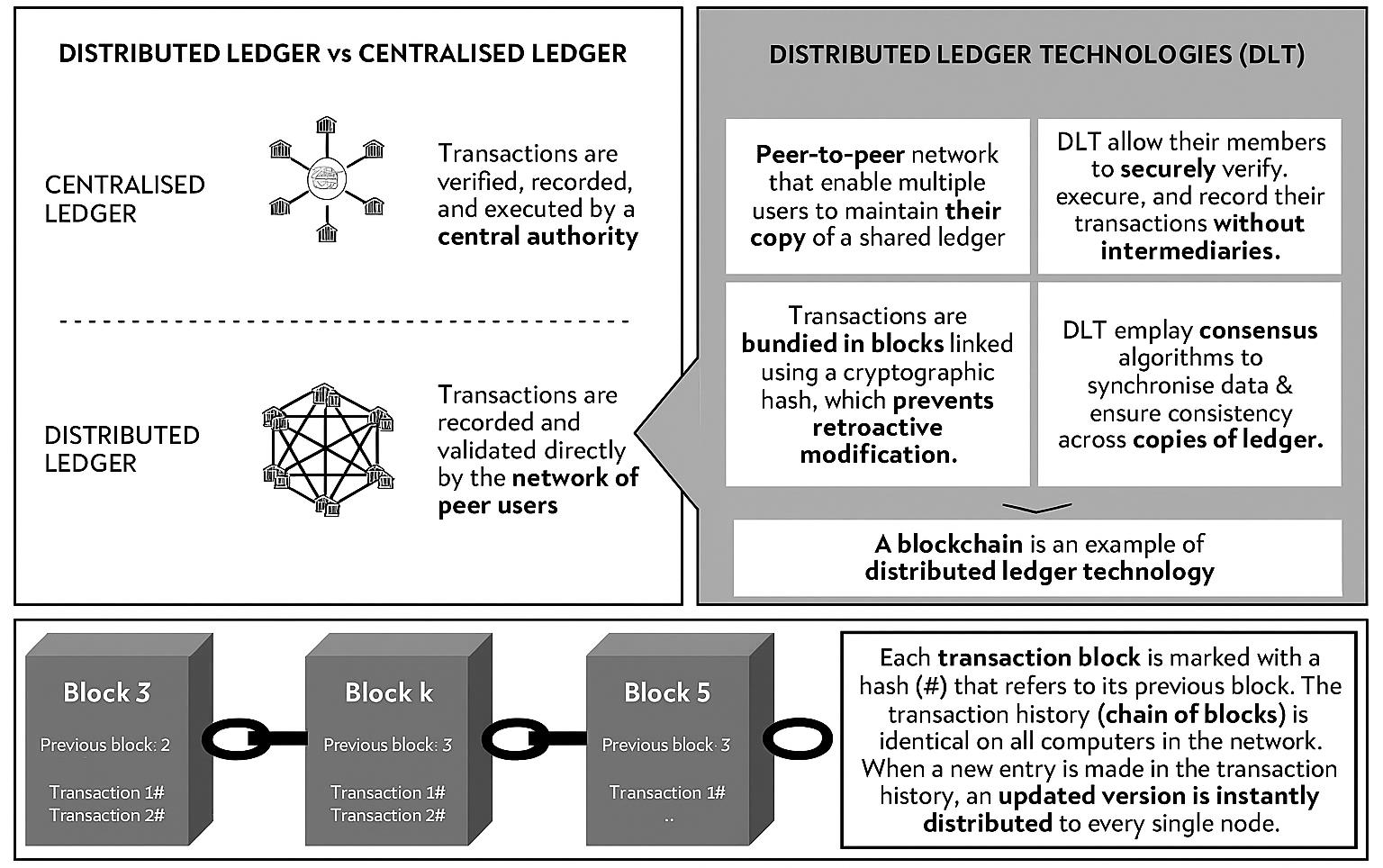
Distributed ledger vs centralised ledger
- Centralised ledger: transactions are verified, recorded, and executed by a central authority.
- Distributed ledger: transactions are recorded and validated directly by the network of peer users.
Distributed ledger technologies (DLT)
- Peer-to-peer network that enables multiple users to maintain their copy of a shared ledger.
- DLT allow their members to securely verify, execute, and record their transactions without intermediaries.
- Transactions are bundled in blocks linked using a cryptographic hash, which prevents retroactive modification.
- DLT employ consensus algorithms to synchronise data & ensure consistency across copies of ledger.
- A blockchain is an example of distributed ledger technology.
| Block | Previous block | Transactions |
|---|---|---|
| Block 3 | 2 | Transaction 1# · Transaction 2# |
| Block k | 3 | Transaction 1# · Transaction 2# |
| Block 5 | 3 | Transaction 1# · .. |
Each transaction block is marked with a hash (#) that refers to its previous block. The transaction history (chain of blocks) is identical on all computers in the network. When a new entry is made in the transaction history, an updated version is instantly distributed to every single node.
Classification of digital assets
Digital assets fall into two main groups.
Coin
A digital asset can be classified as a coin if it can operate independently using its own blockchain platform. Cryptocurrencies such as Bitcoin or Ethereum fall into this category. There is no issuer responsible for any claim.
Token
A digital asset that cannot run independently and depends on another blockchain platform to operate is classified as a token. Due to the many advantages of entering the Ethereum blockchain, many instruments on the Ethereum blockchain use the ERC-20 standard.
Digital assets can be further classified according to their economic function.
Native token
Native tokens, referring to payment tokens from FINMA definition, are intended to be used, now or in the future, as a means of payment for acquiring goods or services or as a means of money or value transfer. Payment tokens give rise to no claims on their issuer.
Utility, Service & Governance Token (USG)
Utility, Service & Governance Tokens (USG), referring to utility tokens from FINMA definition, are intended to provide digital access to an application or service by means of a blockchain-based infrastructure.
Security token
Security tokens, referring to asset tokens from FINMA definition, represent assets such as a debt or equity claim on the issuer. With respect to their economic function, they are analogous to equities, bonds, or derivatives. Tokens and coins enabling physical assets to be traded on the blockchain also qualify as security tokens.
Storage of digital assets
Digital Assets rely on cryptography to initiate transaction. Hence, cryptographic keys (or 'private keys') must be carefully safeguarded. These keys are typically managed through an application called a 'wallet'. Wallets can implement either 'hot' storage or 'cold' storage of the keys, as explained below. While an increased level of security comes with less flexibility or accessibility, clients will need to decide on their individual needs.
Hot storage
Online storage – permanently connected to the internet, which allows fast availability but less security.
- Secure hardware security module (HSM)
- Hosted at a secure data center
- All connections encrypted and secured
- Periodic penetration tests relying on science and research partners
- Assets available for trading in ca 1 hour
Cold storage
Offline storage – only connected to the internet for transfer of assets.
- Biometric and physical access controls
- Radio frequency (RF) shielded
- No connection to the internet
- Electronic equipment according to highest standards
- Protected against all known tempest attacks
- Assets available for trading in ca 2 hours
Transfer of digital assets
One of the key elements of digital assets is their decentralised validation and confirmation mechanism. Other participants of the blockchain network have to validate and confirm pending transactions. These participants are called 'miners' and are incentivised and paid for their work by the fees that are embedded in a transaction.
The fees involved have a direct influence on the speed with which a transaction is validated and confirmed by the participating miners. Miners will prioritise pending transactions with higher fees in order to maximise their profits. Transactions with fees that are too low to be commercially attractive for miners will lead to longer processing times.
The size of the fees paid varies. They largely depend on the overall transaction volume, but they also depend on the asset's price. Developments are currently under way (e.g. the Lightning Network) to substantially increase speed and scalability and to decrease transaction costs.
Direct and indirect exposure to digital assets
Direct exposure
- Direct purchasing of digital assets
- Cold/hot storage between bank and market access
- + Direct ownership of coins/tokens
- + Direct booking: client determination and custody of coin/token
- + Advised & execution only offering
- − Technology-and/or fraud-related risks with the protocol or foundation behind the token
Indirect exposure
- Exposure to digital assets through a financial instrument - e.g. funds and structured products (including exchange-traded products)
- + As a financial instrument, trading, portfolio integration, and reporting are straightforward (ISIN, factsheet, etc.)
- + Ability to gain diversified exposure through basket products
- − Sometimes there are counterparty risks
- − Potential for tracking error
Glossary
| Term | Explanation |
|---|---|
| Altcoin | The term Bitcoin refers to the very first (and therefore 'original') digital asset. The term Altcoin is a term to cryptographically secure any other coin or token that is not Bitcoin. |
| API | Application Programming Interface, a set of protocols allowing software applications to communicate with each other. Essentially, an API is a piece of communication software that allows data transfer from one application to another. APIs are available for trading data from the platform to source data. |
| Bitcoin (BTC) | The first digital asset, issued by Satoshi Nakamoto in 2009. Bitcoin is decentralised and not regulated by any central authority. New units are generated by the solution of mathematical puzzles from the public ledger. Newcomers into the cryptoasset space often confuse Bitcoin with blockchain technology. |
| Blockchain | A decentralised ledger platform where participants can transact without the need for a central authority. Users can access, validate, and record transactions due to the blockchain's decentralised nature. |
| DAPP | Decentralised APPLICATIONS (DAPP) are applications built on a blockchain. The term DAPP refers to an application that is serverless and whose data is maintained by a peer-to-peer network. A DAPP can be implemented for example, for voting, ensuring no double voting, token issuance, and making protocol changes that require consensus by members. |
| DLT | Distributed ledger technology, a consensus of replicated, shared, and synchronised digital data geographically spread across multiple sites, countries, and/or institutions. |
| Ethereum (ETH) | An open-source blockchain platform that allows participants to run applications on it. Its native currency is called 'Ether' and is needed to run an application on the Ethereum blockchain. |
| Initial Coin Offering (ICO) | Capital investment raising by legal entities who wish to offer coins or tokens. Due to fewer requirements, ICOs can be much easier than traditional fundraising methods such as Initial Public Offerings (IPOs). |
| Node | A network member (computer) holding a copy of the ledger's database. Each block, transaction, or data shared with the blockchain is verified by nodes. Each node is connected to several other nodes and shares data with them. |
| Private key | A private key is a form of cryptography that allows a user access to assets publicly calculable from the key but the key has to be kept private to prevent access by unauthorized users. |
| Proof of stake | Proof of stake is a form of consensus mechanism used to validate transactions and maintain data records. To validate blocks based on the amount of coins held by validators. Because no complex mathematical puzzles need to be solved, the proof of stake mechanism is less energy-intensive than proof of work. |
| Proof of work | Proof of work is a consensus mechanism used to confirm transactions and add new blocks to the chain. This requires miners to solve a very complex mathematical puzzle. To win the right to mine a block, miners compete with each other. The first miner to solve the puzzle receives a reward. For Bitcoin, this Bitcoin reward is currently 6.25 BTC, or USD 160,000 in 2021, on average. |
| Public key | Similar to how bank accounts can be known, the sender or transmitter of assets will know the public key. |
| Stablecoin | A cryptocurrency with very low volatility that is usually pegged to a currency or commodity. Stablecoins are often used by traders who want easy gains from cryptocurrency investments but wish to avoid regulatory fees. |
| Staking | Staking or locking up coins in a network to help the blockchain validate transactions and earn rewards. This helps secure the network and ensure that new transactions are added to the blockchain. Staking is usually called 'validating'. Validators are rewarded with new coins from the network. |
| Security token offering (STO) | An STO combines the technology of blockchain with the requirements of regulated securities markets to support liquidity and wider availability of assets in a regulated environment. In terms of regulated securities, STOs digitize traditional forms of regulated securities. In terms of legal aspects, these represent ownership of assets (e.g., gold, real estate) or economic rights (e.g., a share of profits or revenue). |
| Tempest attack | An attack using electromagnetic radiation to remotely track what is displayed on a screen without physical connection. |
| Token | A cryptographic digital asset operating on a particular blockchain. The advent of many instruments on the Ethereum blockchain and its standardized format, ERC-20, has made tokens very popular. |
| Wallet | A private digital wallet used to store, send, and receive digital assets in various ways, including sending messages related to transfers. Wallets are available from simple software modules to dedicated hardware modules. |
Important legal information
U Wealth SA – 8C avenue de Champel, 1206 Genève, Suisse. Supervised by FINMA (Swiss Financial Market Supervisory Authority). This content is provided for informational and educational purposes only. It does not constitute marketing material, nor is it the result of independent financial/investment research. It has not been prepared in accordance with the legal requirements designed to promote the independence of financial research and is not subject to any prohibition on dealing ahead of the dissemination of such research.
Informational purposes only
All information and opinions were valid at the time of writing and are subject to change without notice. This document is provided for informational purposes only and does not constitute legal, tax, accounting or investment advice, nor does it constitute an offer or invitation to buy or sell any financial instrument. Opinions expressed herein reflect the current views of the authors but not necessarily those of U Wealth SA as a whole. While the information is believed to be accurate and sourced from reliable providers, U Wealth SA makes no warranty as to its accuracy, completeness, or timeliness. U Wealth SA accepts no liability, to the extent permitted by law, for any direct or indirect damages or losses arising from the use of this material or any decisions taken based on it.
Suitability & professional advice
Investments mentioned may not be suitable for all investors. Each investor should consider the suitability of an investment to their personal circumstances and objectives and consult their professional advisor before making any financial decision. This content does not constitute a personal recommendation and does not take into account your personal investment profile or financial situation.
Sustainability / ESG
This material does not necessarily adhere to ESG regulations or standards that may apply in other jurisdictions. For details on ESG criteria and any potential impact on financial return or investment eligibility, please contact U Wealth directly.
General risks
The value of and income from investments may rise or fall, and investors may not recover the amount invested. Financial instruments may be exposed to various risks, including but not limited to market, credit, political, and currency risks. Past performance and simulated returns are not reliable indicators of future performance. Structured products mentioned do not represent collective investment schemes under Swiss law and are not supervised by FINMA as such. Investors do not benefit from the specific protections provided by the Swiss Federal Act on Collective Investment Schemes.
Third-party data
Some information may originate from third-party providers such as credit rating agencies, financial data sources, or ESG data platforms. U Wealth SA does not guarantee the accuracy or completeness of this data and declines any liability related to its use.
Restricted distribution
This content is intended solely for recipients located in Switzerland and is not directed to any person or entity in any jurisdiction where its distribution would be contrary to local laws or regulations. This document may not be reproduced or distributed without prior written consent from U Wealth SA. UNITED STATES: NEITHER THIS CONTENT NOR ANY COPY THEREOF MAY BE SENT, TAKEN INTO OR DISTRIBUTED IN THE UNITED STATES OR TO ANY US PERSON. © U Wealth, 2025
Contact information
contact@uwealth.ch | +41 (0)22 545 51 40