
Educational Pack · 04
Equities
Source PDF: GUIDE-TO-UNDERSTANDING-ASSET-CLASSES-EQUITIES.pdf
U Wealth : Your partner in mastering financial instruments. We want you to feel comfortable making suitable investment decisions based on knowledge of the opportunities and risks of given financial instruments. — September 2026
What are equities?
Equities (also called 'shares' or 'stocks') are a share of a company's capital. A shareholder participates in the success or non-success of a company's business results by sharing its financial risks but also returns.
There are different types of shares. In particular, there are registered shares, where shareholders' names are logged in a share register, and bearer shares, where there is no such registration.
Shareholders have various rights, such as financial, information, subscription, compensation, exchange, settlement, and voting rights, as well as the right to participate in liquidation proceeds.
There are normally two reasons to invest in shares: 1. to generate wealth by participating in the long-term capital gain of a company's value (capital gain). 2. to generate income by participating in a company's business results in the form of a distribution of dividends payments.
Advantages / Disadvantages
Share prices are a function of supply and demand. Demand is strongly dependent on a company's economic performance, as well as on the overall national and international economic environment.
If a company requires additional capital, shareholders may receive a so-called 'subscription right' that allows them to subscribe to new or additional shares at a predefined price and subscription ratio. Depending on whether the right is tradeable or not, the price of the right is included in the share price. If the right is traded on an individual basis, the share price is reduced by the value of the right's price.
Advantages
- Shares afford direct participation in a company's financial future.
- Accessibility, liquidity, and versatility: publicly traded shares are usually liquid financial instruments that offer a wide range of investment opportunities worldwide.
- There are two types of investment return: dividend yield and capital gain.
- Equities have historically outperformed other asset classes over the long term.
Disadvantages
- Predictability: past performance is no indicator of future returns.
- Medium-term fluctuations: past performance trends can reverse in the medium term.
- Volatility: stocks are subject to sudden price changes, the cause of which is not always clear to the investor.
- Brokerage costs decrease the return from the investment.
- Dividends are not guaranteed; they can be omitted or cancelled. For example, when a company is in liquidation, shareholders rank behind other creditors in terms of the order of payment.
Important risks to consider
Shares are traded according to the balance between supply and demand. The price of a share expresses investors' expectations regarding the future value of, and return from, that share. When deciding about these expectations, investors evaluate two main risk factors: the economic environment (market risk) and the specific situation of the company invested in (company-specific risk).
| Risk factor | Type of risk | Explanation | Consequences |
|---|---|---|---|
| Market risk | General economic environment | All equities are equally exposed to market risk in terms of the general economic environment. For example, a change in the interest rate usually affects share pricing in general, without a specific relation to the individual company's development. | Shares can be subject to sudden price changes, the cause of which may be unclear to the investor (predictability). |
| Market psychology | A regulated market is a market of expectations. Not all expectations are rational. In particular, market participants tend to enforce and even exaggerate trends. | Shares are volatile investments on a short-term basis. | |
| Company-specific risk | Profitability | Shareholders are entitled to participate in the profitability of the company invested in. The company's economic situation and management success determine whether a return can be distributed in the form of a dividend, and if so, in what amount. | Dividend payments are not guaranteed. Past performance is no indicator of future returns. |
| Insolvency | In case of insolvency, shareholders only participate in the liquidation capital after other investors have been compensated (e.g. bondholders). | A shareholder bears the risk of a total loss of the invested capital. |
When equities are traded in currencies other than the home currency, there is an additional risk of changes in foreign exchange rates.
What to expect from equities
Investment horizon
- Medium term
- Longer term
- Short term
Income expectation
- Capital gain
- Irregular dividends
Market expectation
- Increasing (1)
Important to know before investing in equities
Maximum gain
Unlimited: dividends earned plus any capital gain realized.
Maximum loss
Total loss of capital in case of insolvency of the company invested in.
Profit/loss
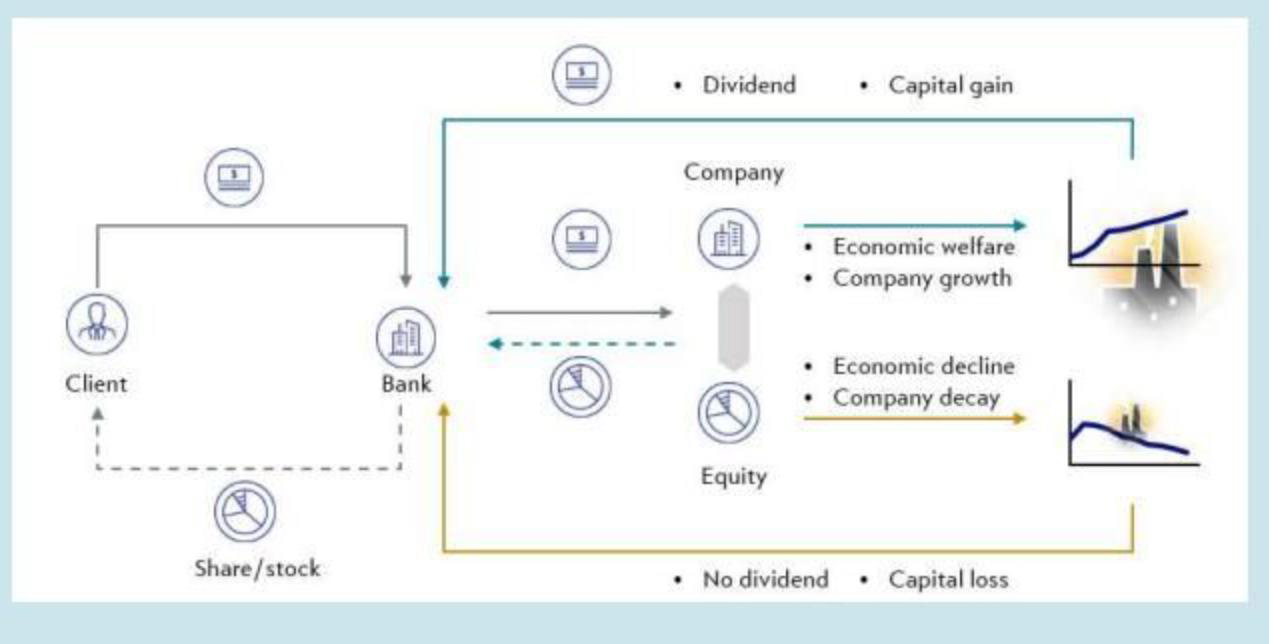
The return from an investment in a specific share cannot be predicted. The investor participates in the economic performance of the company, sharing its risks and returns.
| Scenario | Outcome |
|---|---|
| Company — positive development | Economic welfare · Company growth → Dividend · Capital gain |
| Equity — negative development | Economic decline · Company decay → No dividend · Capital loss |
Equities vs equity
The term 'equity' in finance refers to:
- the residual value of a company when all liabilities are deducted from the assets
- any type of security that claims an ownership participation
Equities are the most common form of such securities. They represent an investor's share in the ownership of a company.
General types of shares
Shares are usually very liquid investment instruments. They are extremely versatile and easily accessible. Shares can be classified in many ways. It is common to classify them according to voting rights and to the potential to transfer.
According to voting rights
- Common stock: holders of common stock bear the right to vote on company decisions.
- Preferred stock: holders of preferred stock do not usually bear any voting rights, in exchange for preferred treatment on dividend payments.
According to the potential to transfer
- Registered shares: the holder's name is entered in a share register; these shares are not easily transferable. Registered shares involve higher administrative costs, but allow companies to know who their shareholders are and make hostile takeovers more difficult.
- Bearer shares: there is no registration; these shares are easily transferable.
Value and return of a share
The value of a share is determined mainly by the performance (and performance expectation) of the company and the wider market environment (economic conditions and climate).
Companies listed on a stock exchange publish their results at regular intervals. Additionally, listed companies are obliged to publicly notify investors about any corporate events that may influence investors' expectations about the companies' future performance and hence the price of the companies' shares. Such events include:
- takeover bids
- mergers with other companies
- launch of new products.
Shares create two types of return for investors.
| Capital gain | Dividend payments |
|---|---|
| If the company is prospering, its value and consequently the price of its shares will rise accordingly. | A dividend is a distribution of a part of the company's income to its shareholders. The board of directors decides whether to pay a dividend, and if so, in what amount, after taking into account other needs and requirements (e.g. investments, reserves). Dividends can take the form of cash payments or additional shares. |
Cost types
The purchase and sale of shares create costs for the investor.
Bid/Ask spread
The amount by which the ask price exceeds the bid price for an asset in the market. The bid/ask spread is essentially the difference between the highest price that a buyer is willing to pay for an asset and the lowest price that a seller is willing to accept.
Broker & bank fees
Brokers and banks charge fees for their services depending on the type of asset, the market place, and transaction volume. Minimum fees per transaction can apply.
Commissions
Can be charged by exchanges. Stock exchange fees can vary markedly from one exchange to another.
Taxes
Such as stamp duty, can be levied when buying shares of a company.
Currency conversions
Can create additional costs.
Order types
Stocks are traded continuously. There is always a time lag between the placement and the execution of an order. Thus, when placing an order, the price at the exact time of execution is unknown. Order instructions can be given when placing orders. Such instructions may include 'market', 'limit', 'stop', or 'stop-limit' orders.
| Order type | Description |
|---|---|
| 1 · Market order | An order to buy or sell a stock at the best available price. Generally, this type of order is executed immediately. However, the price at which a market order is executed is not guaranteed. It is important for investors to remember that the last-traded price is not necessarily the price at which a market order is executed. In fast-moving markets, the price at which a market order is executed often deviates from the last-traded price or 'real time' quote. |
| 2 · Limit order | An order to buy or sell a stock at a specific price or better. A buy limit order can only be executed at the limit price or lower, and a sell limit order can only be executed at the limit price or higher. |
| 3 · Stop order | Also referred to as a 'stop-loss order', is an order to buy or sell a stock once the price of the stock reaches a specified price, known as the 'stop price'. When the stop price is reached, a stop order becomes a market order. A buy stop order is entered at a stop price above the current market price. Investors generally use a buy stop order to limit a loss or to protect a profit on a stock that they have sold short. A sell stop order is entered at a stop price below the current market price. Investors generally use a sell stop order to limit a loss or to protect a profit on a stock that they own. |
| 4 · Stop-limit order | An order to buy or sell a stock that combines the features of a stop order and a limit order. Once the stop price is reached, a stop-limit order becomes a limit order that will be executed at a specified price (or better). The benefit of a stop-limit order is that the investor can control the price at which the order can be executed. |
Important legal information
U Wealth SA – 8C avenue de Champel, 1206 Genève, Suisse. Supervised by FINMA (Swiss Financial Market Supervisory Authority). This content is provided for informational and educational purposes only. It does not constitute marketing material, nor is it the result of independent financial/investment research. It has not been prepared in accordance with the legal requirements designed to promote the independence of financial research and is not subject to any prohibition on dealing ahead of the dissemination of such research.
Informational purposes only
All information and opinions were valid at the time of writing and are subject to change without notice. This document is provided for informational purposes only and does not constitute legal, tax, accounting or investment advice, nor does it constitute an offer or invitation to buy or sell any financial instrument. Opinions expressed herein reflect the current views of the authors but not necessarily those of U Wealth SA as a whole. While the information is believed to be accurate and sourced from reliable providers, U Wealth SA makes no warranty as to its accuracy, completeness, or timeliness. U Wealth SA accepts no liability, to the extent permitted by law, for any direct or indirect damages or losses arising from the use of this material or any decisions taken based on it.
Suitability & professional advice
Investments mentioned may not be suitable for all investors. Each investor should consider the suitability of an investment to their personal circumstances and objectives and consult their professional advisor before making any financial decision. This content does not constitute a personal recommendation and does not take into account your personal investment profile or financial situation.
Sustainability / ESG
This material does not necessarily adhere to ESG regulations or standards that may apply in other jurisdictions. For details on ESG criteria and any potential impact on financial return or investment eligibility, please contact U Wealth directly.
General risks
The value of and income from investments may rise or fall, and investors may not recover the amount invested. Financial instruments may be exposed to various risks, including but not limited to market, credit, political, and currency risks. Past performance and simulated returns are not reliable indicators of future performance. Structured products mentioned do not represent collective investment schemes under Swiss law and are not supervised by FINMA as such. Investors do not benefit from the specific protections provided by the Swiss Federal Act on Collective Investment Schemes.
Third-party data
Some information may originate from third-party providers such as credit rating agencies, financial data sources, or ESG data platforms. U Wealth SA does not guarantee the accuracy or completeness of this data and declines any liability related to its use.
Restricted distribution
This content is intended solely for recipients located in Switzerland and is not directed to any person or entity in any jurisdiction where its distribution would be contrary to local laws or regulations. This document may not be reproduced or distributed without prior written consent from U Wealth SA. UNITED STATES: NEITHER THIS CONTENT NOR ANY COPY THEREOF MAY BE SENT, TAKEN INTO OR DISTRIBUTED IN THE UNITED STATES OR TO ANY US PERSON. © U Wealth, 2025
Contact information
contact@uwealth.ch | +41 (0)22 545 51 40