
Educational Pack · 10
Money Market
Source PDF: GUIDE-TO-UNDERSTANDING-ASSET-CLASSES-MONEY-MARKET.pdf

U Wealth : Your partner in mastering financial instruments. We want you to feel comfortable making suitable investment decisions based on knowledge of the opportunities and risks of given financial instruments. — September 2026
What are money market investments?
Money market investments are highly liquid securitised or unsecuritised short-term investments. They are essentially debt obligations.
Money market instruments can serve as a 'stopover' for excess cash between longer-term investments.
- Call deposits: placements, movements (increase/decrease), and redemptions possible with 48 hours' notice.
- Time deposits: the money is lent for a specific period of time, usually between one week and one year.
Advantages / disadvantages
| Advantages | Disadvantages |
|---|---|
| Higher returns than a savings account | Lower returns compared to riskier/more volatile short-term investment instruments |
| Liquidity: depending on the time frame chosen, money can be withdrawn quickly. | Interest-rate risk on roll-over |
| Less volatile than alternative short-term investments | Inflation risk: as rates are usually low, the return can be diminished by inflation. |
| Low default risk (depending on the counterparty, even guaranteed investments) | Account minimums usually apply |
| Access to short-term interest rates | Credit risk: risk of the bank holding the deposit becoming insolvent |
| Low fees and taxes |
Important risks to consider
| Issuer's credit risk | Liquidity risk | Market risk |
|---|---|---|
| Money market investments are debt obligations. Evaluate the issuer's creditworthiness, as it impacts direct time/call deposits (investing directly with a bank) and fiduciary deposits (bank invests for your risk). | Money market investments can be less liquid than other instruments, meaning they might not be readily convertible to cash depending on their terms. | Low interest rates expose investments to inflation risk, potentially diminishing returns. There's also reinvestment risk (not securing the same rate) and currency risk for foreign currency investments. |
What to expect from money market investments
| Investment horizon | Income expectation | Market expectation |
|---|---|---|
| Short term | Regular interest | Independent |
Important to know before investing in time and call deposits
| Maximum gain | Maximum loss | Profit/loss |
|---|---|---|
| Interest earned | Theoretical possibility of total loss of investment in case of default of the debtor | Rates offered depend on maturity and investment volumes. Minimum investment volumes apply: usually CHF 250,000 for call deposits and CHF 100,000 for time deposits. There is an interest-rate risk on roll-over/reinvestment of the capital at maturity. When investing for longer time periods, inflation can eat up a certain part of the return. |
A closer look at money market
Basic properties of money market investments
- Trading of money market instruments is done either over the counter (OTC), i.e. directly between the lender and the borrower (debtor), or at an exchange, if the product is standardised (e.g. US Treasury bills).
- The time to maturity is usually short (up to approximately one year).
- The main counterparties are larger institutions such as banks, other financial institutions, countries/governments, or industries.
- Contracts have a minimum denomination and size.
| Banks | Non-banks |
|---|---|
| Time/call deposits | Registered money market claims |
| Fiduciary deposits | Commercial papers |
| Certificate of deposit | US Treasury bills |
| Repurchase agreements |
Interest and interest rates
Money market investments (like other instruments, e.g. fixed income) offer interest in return for a loan.
The basis of the interest rate offered is a reference rate minus a spread representing the service margin. Important reference rates are:
- LIBOR (London Interbank Offered Rate): the Libor is the interest rate at which banks offer each other short-term funding. It is fixed daily as an average of the rates offered by the reference banks.
- EURIBOR (Euro Interbank Offered Rate) is a reference rate of 41 large banks for fixed-term deposits.
- The LIBOR/EURIBOR interest-rate benchmarks will disappear and a transition to alternative reference rates (ARRs), also known as risk-free rates (RFRs), will take place. ARRs are overnight interest rates that incorporate little or no credit risk. Furthermore, the markets underlying the ARRs are significantly more active than the markets underpinning the IBORs. Hence, while IBORs rely significantly on expert judgement, ARRs are purely transaction-based.
Alternative interest rate
| Currency | Current rate | Alternative reference rate (ARR) | ARR description |
|---|---|---|---|
| CHF | LIBOR | Swiss average rate overnight (SARON) | Secured (overnight repo rate); fully transaction-based |
| USD | LIBOR | Secured overnight financing rate (SOFR) | Secured (overnight repo rate); fully transaction-based; solid underlying market |
| GBP | LIBOR | Sterling overnight index average (SONIA) | Unsecured and overnight; fully transaction-based; solid underlying market |
| JPY | LIBOR | Tokyo overnight average rate (TONAR) | Unsecured and overnight; weighted by transaction volume |
| EUR | EONIA, EURIBOR | Euro short-term rate (ESTR) | Unsecured and overnight; reflects the financing costs of banks in the eurozone |
- Interest income is calculated by using specific day-count conventions, i.e. the number of days in a month/year.
- Day-count conventions have developed historically as a result of the need for easy calculation and time-period constancy.
- A number of different conventions exist, such as the '30/360 method' (counting 30 days for each month, and 360 days for the full year), the 'actual/actual method' (actual days of the months and 365—or 366 in leap years—for the year), and the 'actual/360 method' (actual days in month and 360 for full year).
How money market work
Example: Call and time deposits
- Call deposits have an undefined maturity. The money is callable within a notice period of 48 hours.
- Time deposits are made for a fixed period of time and are redeemed at the end of that period.
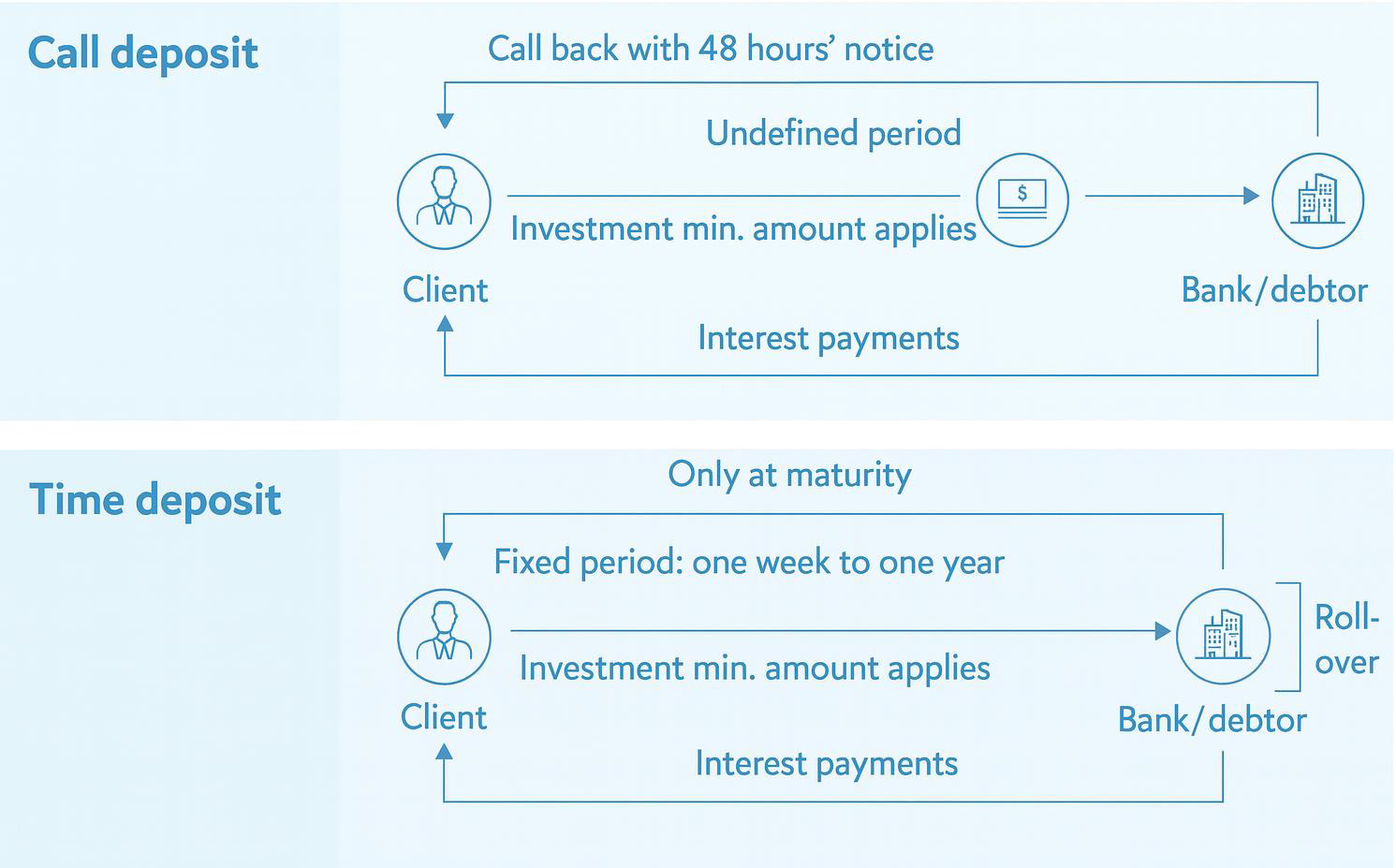
Specific properties — call and time deposits
| Call deposit | Time deposit |
|---|---|
| The minimum investment volume is CHF 250,000 or foreign currency equivalent. | The minimum investment volume is CHF 100,000 or foreign currency equivalent. |
| The interest rates differ, depending on the investment horizon, investment volume, and counterparty risk. | The interest rates differ, depending on the investment horizon, investment volume, and counterparty risk. |
| Call deposits are generally available in major non-domestic currencies. | Time deposits are generally only available in domestic currencies. |
| Interest is paid on a quarterly basis. | Interest is paid at maturity. |
| Commission is charged on quarterly basis. | Commission is charged at the starting date. |
Important risks to consider (I) — call and time deposits
Money market instruments are regarded as being among the safer investments. However, as with any investment, certain risks remain.
- There is a low risk on the capital invested: the default (credit) risk of the custody bank becoming insolvent.
- Since they are regarded as safe investments, returns are lower than for other types of investments. When investing for an extended period (by rolling over the investment), inflation can eat up part of the return from the investment.
- If the deposit is done in any currency other than the home currency, there is also a currency risk.
- Money market instruments are short-term investments. As debt obligations, however, they may be less liquid than other types of financial instrument.
Important risks to consider (II) — call and time deposits
The interest rate (return) of a money market deposit is known at the time of investment. However, interest rates change and thus affect reinvestment/roll-over. Below we outline three possible cases.
Best case — increasing and high interest rates
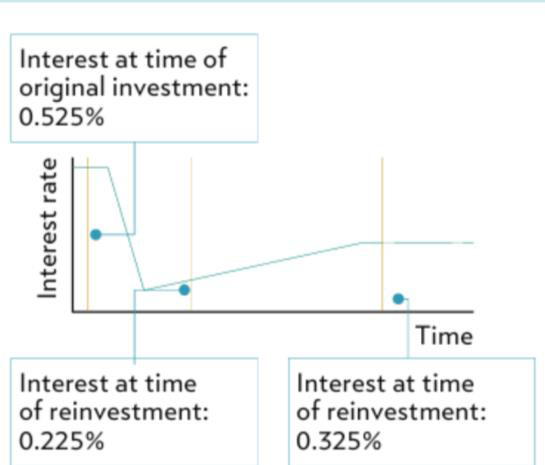
- Increasing return on reinvestment
- The higher the overall interest rate, the higher the return
Realistic case — volatile interest rates
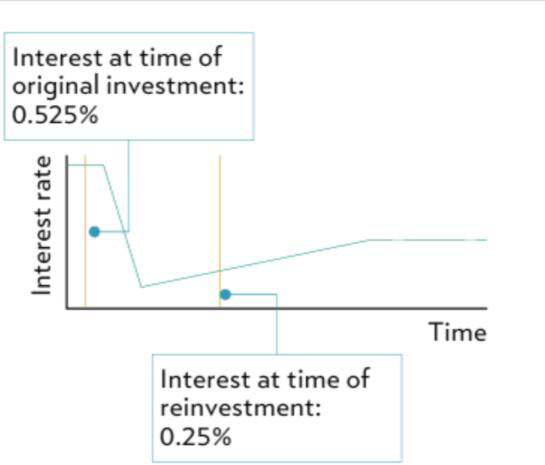
- Varying returns on multiple reinvestments
- The higher the overall interest rate, the higher the return
Worst case — decreasing and low interest rates
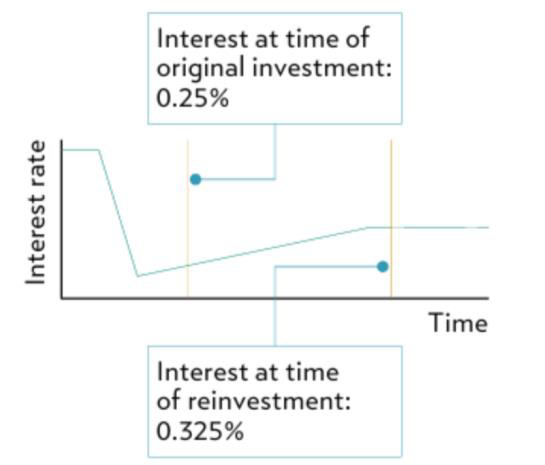
- Decreasing return on reinvestment
- Low overall return
Fiduciary deposits
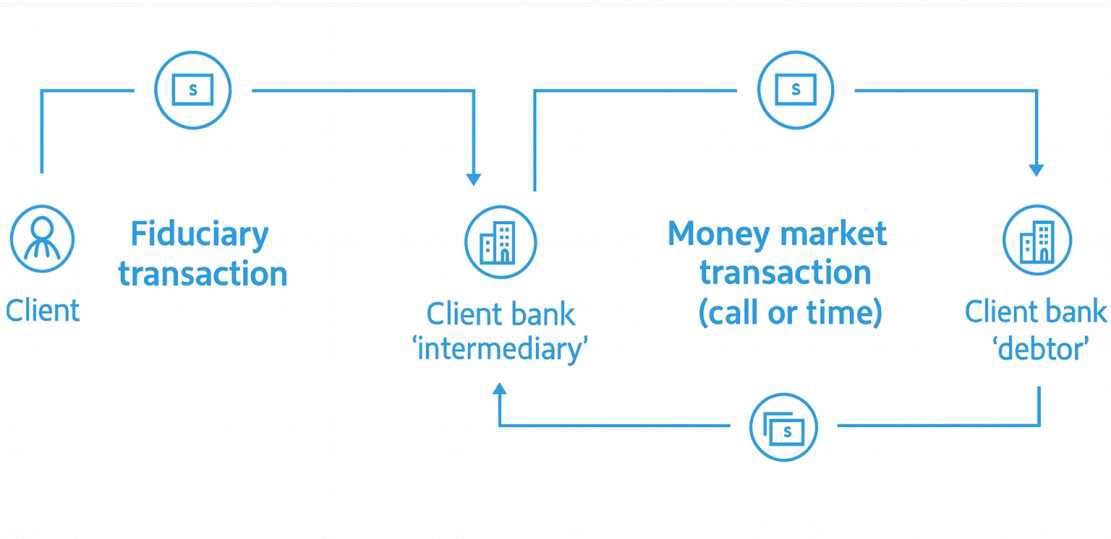
Fiduciary deposits are money market transactions done by a bank in its own name, with a third-party bank, but on the account and risk of the client (i.e. the investor bears the counterparty risk).
Both types of money market instruments previously described (i.e. call and time deposits) are available.
Advantages / disadvantages — fiduciary deposit
| Advantages | Disadvantages |
|---|---|
| Increased confidentiality: the deposit at the third-party bank is done in the name of the client's bank only. | Minimum terms and investment volumes |
| Risk diversification: the counterparty risk can be diversified by placing money with different counterparties. | Costs: the client's bank is due a fee for the services provided. |
| Credit risk: the credit risk the client is exposed to is no longer the one of its own bank but that of the third-party bank, where the money is deposited. | |
| Country/liquidity/market risk: note that the third-party bank may be in another country, which can shift the corresponding risk exposure, compared to a straight money market investment. |
Certificate of deposits and repurchase agreement
Certificate of deposits
- A certificate of deposits (CDs) is a savings certificate entitling the bearer to receive interest. CDs are generally issued by a deposit institution (such as a bank, credit union, or a finance or insurance company).
- The deposit is short term, usually ranging from one to nine months and may be rolled over at the end of the term.
- The deposit is securitised by the issuing bank, i.e. it can be sold prior to maturity.
- High minimum denominations apply.
- Interest rates may be fixed or variable.
- Depending on the specific investment, CDs may be insured (minimising counterparty risk) or callable by the issuer (adding the risk of early termination by the debtor).
Repurchase agreement
- This is an agreement to sell a security and to repurchase it afterwards.
- The return offered is the 'repo rate', i.e. the difference between the sale and the repurchase price.
- Changes in the value of the security during the lifetime of the contract are compensated through a margin account. Thus, if the security loses value, the buyer (i.e. the lender) can generally issue a margin call and demand more money or securities to protect his or her investment.
- Note that due to the mark-to-market compensation, the seller of the agreement bears an additional risk to the ones already mentioned.
Registered money market claims and commercial papers
Registered money market claims
- These are debt obligations of the Swiss Confederation.
- They are unsecuritised discount papers with a maturity of up to 12 months that serve as short-term funding.
- They are issued using a tender process.
Commercial papers
- Commercial papers are issued by private companies (banks, industrial companies).
- They serve as short-term funding (up to nine months).
- They usually have high minimum denominations.
- Commercial papers are issued by sound entities. However, the investor bears the credit risk of the issuing counterparty.
Counterparty risks and ratings
- Money market investments aim to be short-term investments with low risk. They are thus only made with trustworthy counterparties.
- The instruments described in this document all have different counterparties. For example, in the case of registered money market claims, the counterparty is a state (in this case, the Swiss Confederation) that is regarded as among the safest counterparties, while commercial papers are issued by private companies.
- The credit quality of a counterparty for short-term debts is rated by an independent agency such as Moody's. The table below provides an example of such a rating.
| Moody's rating | Explanation |
|---|---|
| Prime–1 | Very strong capacity to meet financial commitments. |
| Prime–2 | Strong capacity to meet financial commitments. |
| Prime–3 | Capacity to meet financial commitments. |
| Not prime | Not prime–speculative. |
- Note that ratings are not investment advice – they are just additional information for the investor.
- Short-term ratings differ from long-term ratings for the bond market. For more on the latter, please refer to U Wealth's educational material on fixed income.
Important legal information
Legal entity
U Wealth SA – 8C avenue de Champel, 1206 Genève, Suisse. Supervised by FINMA (Swiss Financial Market Supervisory Authority).
Educational and Informational Disclaimer
Educational and Informational Disclaimer: This content is provided for informational and educational purposes only. It does not constitute marketing material, nor is it the result of independent financial/investment research. It has not been prepared in accordance with the legal requirements designed to promote the independence of financial research and is not subject to any prohibition on dealing ahead of the dissemination of such research. The content has been prepared by U Wealth SA, which is authorised and regulated by FINMA (Swiss Financial Market Supervisory Authority). The information may be updated irregularly or in response to significant developments.
Informational Purposes Only
Informational Purposes Only: All information and opinions were valid at the time of writing and are subject to change without notice. This document is provided for informational purposes only and does not constitute legal, tax, accounting or investment advice, nor does it constitute an offer or invitation to buy or sell any financial instrument. Opinions expressed herein reflect the current views of the authors but not necessarily those of U Wealth SA as a whole. While the information is believed to be accurate and sourced from reliable providers, U Wealth SA makes no warranty as to its accuracy, completeness, or timeliness. U Wealth SA accepts no liability, to the extent permitted by law, for any direct or indirect damages or losses arising from the use of this material or any decisions taken based on it.
Suitability & Professional Advice
Suitability & Professional Advice: Investments mentioned may not be suitable for all investors. Each investor should consider the suitability of an investment to their personal circumstances and objectives and consult their professional advisor before making any financial decision. This content does not constitute a personal recommendation and does not take into account your personal investment profile or financial situation.
Sustainability / ESG
Sustainability / ESG: This material does not necessarily adhere to ESG regulations or standards that may apply in other jurisdictions. For details on ESG criteria and any potential impact on financial return or investment eligibility, please contact U Wealth directly.
General Risks
General Risks: The value of and income from investments may rise or fall, and investors may not recover the amount invested. Financial instruments may be exposed to various risks, including but not limited to market, credit, political, and currency risks. Past performance and simulated returns are not reliable indicators of future performance. Structured products mentioned do not represent collective investment schemes under Swiss law and are not supervised by FINMA as such. Investors do not benefit from the specific protections provided by the Swiss Federal Act on Collective Investment Schemes.
Third-Party Data
Third-Party Data: Some information may originate from third-party providers such as credit rating agencies, financial data sources, or ESG data platforms. U Wealth SA does not guarantee the accuracy or completeness of this data and declines any liability related to its use.
Restricted Distribution
Restricted Distribution: This content is intended solely for recipients located in Switzerland and is not directed to any person or entity in any jurisdiction where its distribution would be contrary to local laws or regulations. This document may not be reproduced or distributed without prior written consent from U Wealth SA.
United States
UNITED STATES: NEITHER THIS CONTENT NOR ANY COPY THEREOF MAY BE SENT, TAKEN INTO OR DISTRIBUTED IN THE UNITED STATES OR TO ANY US PERSON. © U Wealth, 2025
Contact information
contact@uwealth.ch | +41 (0)22 545 51 40