
Educational Pack · 09
Leveraged Structured Products
Source PDF: GUIDE-TO-UNDERSTANDING-ASSET-CLASSES-LEVERAGED-STRUCTURED-PRODUCTS.pdf
U Wealth : Your partner in mastering financial instruments. We want you to feel comfortable making suitable investment decisions based on knowledge of the opportunities and risks of given financial instruments. — September 2026
What are structured products?
Structured products are synthetic investment products that usually combine two or more financial instruments, one of them often being an option.
The purpose is to tailor the risk properties, which cannot be found in standard financial instruments, in order to suit the specific market expectations and investment objectives of investors.
Structured products can give access to markets not easily covered by other financial instruments.
Structured products are available for a range of risk categories.
In case of ETP, product could also consist of only one Digital Asset as underlying which is not classified as a financial instrument.
Advantages / disadvantages
| Advantages | Disadvantages |
|---|---|
| Can be used to reduce risk by adding them to an existing portfolio. | Returns are not easily predictable. |
| They provide capital protection and volatility reduction. | There can be price uncertainty. |
| They cater to market expectations not easily met by other instruments, e.g. sideways movements of markets or low-yield market environments. | Because they are tailored, the market may be less liquid. |
| They can offer yield enhancement. | Structured products are in most cases unsecured debt, and the credit quality of the issuer (issuer risk) needs to be considered. |
| They have the potential for enhanced returns. | Structured products may be difficult to understand, depending on the product. |
| There is a broad range of assets available. | |
| They are tailored to investors' expectations. |
Important risks to consider
- The choice and quality of the issuer are important.
- Structured products expose the issuer of the product, not the issuer of the underlying, to risks.
- Structured products are very specific instruments; such liquidity may be less than with other products and depends on the issuer’s market making.
Structured products often include option characteristics: the price of the product does not move in a linear way due to varying pricing factors. Thus, the pay-off profile may only be reached at maturity.
If the product is quoted in a different currency, the additional currency risk needs to be considered. Specific structured products may hedge this risk (quanto). Each structured product has its own risk characteristics and suitability for individual market expectations. It may enhance or limit the market risks to which the underlying asset is subject. The following product categories are important.
| Product category (from less risk to more risk) | Short description |
|---|---|
| Capital protection | A product that guarantees a limitation of the risk of total loss under certain conditions. |
| Yield enhancement | A product that combines a fixed income product with an option. |
| Participation | A product that usually carries the full risks of the underlying with/without contingent capital protection. |
| Leverage | Products that make use of leverage effects to maximise possible returns at the risk of total loss. |
| Leverage with knock-out | Products that make use of leverage effects to maximise possible returns at the risk of total loss. |
A structured product is an individual contract with the issuer of the product. Please refer to the product disclosure statements for detailed information on the rights, obligations, and risks involved in a specific investment.
What to expect from structured products
| Investment horizon | Income expectation | Market expectation |
|---|---|---|
| Short term | Capital gain | Different product categories cater to different market expectations. See following pages for further details. |
| Medium term | Regular interest | |
| Long term | Irregular dividends |
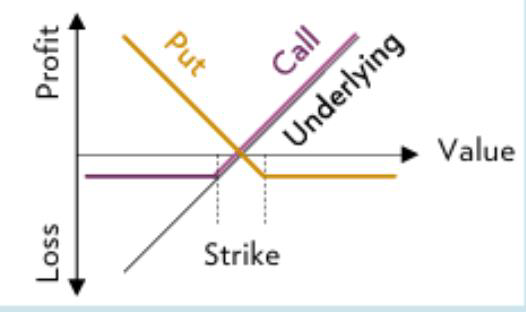
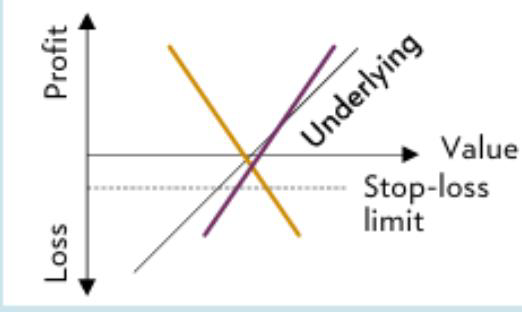
Important to know before investing in leverage without knock-out
| Class | Warrant | Leverage without knock-out |
|---|---|---|
| Maximum gain | Difference between strike and actual price of underlying asset | Difference between strike and actual price of underlying multiplied by leveraging factor |
| Maximum loss | Total loss of capital invested | Total loss or up-to-redemption amount in case of a stop-loss limit |
| Profit/loss | Different ratios available; Available for different market expectations (call and put); Useable for hedging purposes; Constant surveillance of product needed; No short sales possible | Early redemption in case stop-loss limit is triggered; Leverage maximises returns at the cost of higher risks |
| Expectations | Available for both rising and declining value of underlying | Available for both rising and declining value of underlying |
| Specific risks | Products include leverage. Their price may react in a non-linear way to changes in the market value of the underlying asset. | If the value of the underlying assets falls below the barrier, the loss can theoretically be as high as the capital invested, with the exception of any coupon payment that took place. The price of the product may fall already if the underlying value drops near the barrier without touching it. |
| Comments | Behaves similarly to options; The liquidity depends on the liquidity of the underlying | Products using futures as an underlying may suffer from rolling costs |
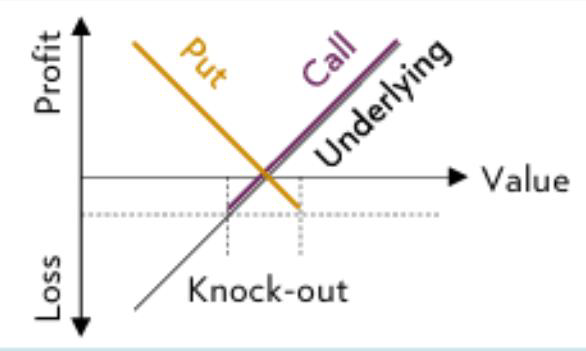
Important to know before investing in leverage with knock-out
| Class | Warrant with knock-out |
|---|---|
| Maximum gain | Difference between strike and actual value of underlying |
| Maximum loss | Total loss of capital invested |
| Profit/loss | Different ratios available; Product immediately terminated as worthless when knock-out price is reached; Less influenced by time decay and volatility; No short sales available |
| Expectations | Available for both rising and declining value of underlying |
| Specific risks | Products include leverage. Their price may react in a non-linear way to changes in the market value of the underlying asset. The product may terminate early and becomes worthless even before maturity when knock-out is reached. |
A closer look at exchange traded products (ETP)
What are ETP?
- ETP are a sub-category of structured products and hence are technically considered as structured products but can also have many elements of fund similar instruments
- The main difference is that ETP are listed and traded on exchanges while structured products are mostly traded on primary markets
- ETP can be benchmarked to various investments categories, such as commodities, currencies, stocks, bonds or digital assets
| Structured product (SP) | Exchange traded product (ETP) | |
|---|---|---|
| Legal structure | Often unsecured debt obligations of financial institutions | Legally ETPs are non-interest bearing notes (structured products); Usually set up via Special Purpose Vehicle (SPV) |
| Ownership of underlying asset? | Debt contract promises return linked to underlying asset; but SP may be hedged (1:1) or not; Can trade at premium/discount to NAV and has counterparty risk | Debt contract promises return linked to underlying asset; ETP are typically 100% collateralized |
| Trading | Mostly primary markets (subscription and redemption at NAV); Secondary trading possible: Issuer makes OTC market | Market making via Authorized Participants; Analogous to ETF: Trading difference minimized |
Important legal information
Legal entity
U Wealth SA – 8C avenue de Champel, 1206 Genève, Suisse. Supervised by FINMA (Swiss Financial Market Supervisory Authority).
Educational and Informational Disclaimer
Educational and Informational Disclaimer: This content is provided for informational and educational purposes only. It does not constitute marketing material, nor is it the result of independent financial/investment research. It has not been prepared in accordance with the legal requirements designed to promote the independence of financial research and is not subject to any prohibition on dealing ahead of the dissemination of such research. The content has been prepared by U Wealth SA, which is authorised and regulated by FINMA (Swiss Financial Market Supervisory Authority). The information may be updated irregularly or in response to significant developments.
Informational Purposes Only
Informational Purposes Only: All information and opinions were valid at the time of writing and are subject to change without notice. This document is provided for informational purposes only and does not constitute legal, tax, accounting or investment advice, nor does it constitute an offer or invitation to buy or sell any financial instrument. Opinions expressed herein reflect the current views of the authors but not necessarily those of U Wealth SA as a whole. While the information is believed to be accurate and sourced from reliable providers, U Wealth SA makes no warranty as to its accuracy, completeness, or timeliness. U Wealth SA accepts no liability, to the extent permitted by law, for any direct or indirect damages or losses arising from the use of this material or any decisions taken based on it.
Suitability & Professional Advice
Suitability & Professional Advice: Investments mentioned may not be suitable for all investors. Each investor should consider the suitability of an investment to their personal circumstances and objectives and consult their professional advisor before making any financial decision. This content does not constitute a personal recommendation and does not take into account your personal investment profile or financial situation.
Sustainability / ESG
Sustainability / ESG: This material does not necessarily adhere to ESG regulations or standards that may apply in other jurisdictions. For details on ESG criteria and any potential impact on financial return or investment eligibility, please contact U Wealth directly.
General Risks
General Risks: The value of and income from investments may rise or fall, and investors may not recover the amount invested. Financial instruments may be exposed to various risks, including but not limited to market, credit, political, and currency risks. Past performance and simulated returns are not reliable indicators of future performance. Structured products mentioned do not represent collective investment schemes under Swiss law and are not supervised by FINMA as such. Investors do not benefit from the specific protections provided by the Swiss Federal Act on Collective Investment Schemes.
Third-Party Data
Third-Party Data: Some information may originate from third-party providers such as credit rating agencies, financial data sources, or ESG data platforms. U Wealth SA does not guarantee the accuracy or completeness of this data and declines any liability related to its use.
Restricted Distribution
Restricted Distribution: This content is intended solely for recipients located in Switzerland and is not directed to any person or entity in any jurisdiction where its distribution would be contrary to local laws or regulations. This document may not be reproduced or distributed without prior written consent from U Wealth SA.
United States
UNITED STATES: NEITHER THIS CONTENT NOR ANY COPY THEREOF MAY BE SENT, TAKEN INTO OR DISTRIBUTED IN THE UNITED STATES OR TO ANY US PERSON. © U Wealth, 2025
Contact information
contact@uwealth.ch | +41 (0)22 545 51 40