
Educational Pack · 08
Investment-Grade Bonds
Source PDF: GUIDE-TO-UNDERSTANDING-ASSET-CLASSES-INVESTMENT-GRADE-BONDS.pdf
U Wealth : Your partner in mastering financial instruments. We want you to feel comfortable making suitable investment decisions based on knowledge of the opportunities and risks of given financial instruments. — September 2026
What is fixed income?
Fixed income instruments are financial investments where the issuer is obliged to make payments on a predetermined schedule.
These debt obligations do not represent any ownership in the company/institution of the issuer. For example, the borrower pays interest on a 'vanilla bond' at periodic intervals and eventually pays back the investment amount at a specified maturity date.
Fixed income instruments serve investment objectives that target the generation of steady cash flows and/or the preservation of capital. Examples are bonds and convertibles.
Advantages / disadvantages
Bonds — advantages
- Predictability: bond returns are more predictable than returns from other types of investments.
- Regular income: bonds generate a regular source of income.
- Less volatility/more stability: bond price variation is lower and less pronounced with changing market conditions compared to other investments.
- Reduced risk: bonds (as a loan, i.e. debt capital) are more secure than other investments (e.g. stocks as equity capital) when selecting creditworthy debtors.
Bonds — disadvantages
- Default risk: credit default risk is one major risk factor for bonds and must be borne in mind when deciding to invest.
- Liquidity considerations: the capital is locked if the bond is held to maturity.
- Lower returns: bonds offer lower returns compared to other investments, specially in the long term.
- Interest-rate risk: interest rates influence the present value, and therefore the price, of the bond.
Important risks to consider
Bonds and notes
| Risk | Description |
|---|---|
| Market risk | The price of bonds and notes fluctuates. This is influenced by interest-rate fluctuations. The bond does not entail a currency risk for the investor, if the currency risk and national risk factors are hedged. |
| Credit risk | Credit risk of the issuer: this is a main risk to be considered when investing in bonds and notes. Inflation risk and national factors can influence the expected redemption from bonds. Additional factors and hence exposures need to be considered in case the issuer defaults. |
| Bond coverage | A bond may be covered by other assets of the issuer. |
| Bond seniority | A bond may be ranked according to which bonds are redeemed first from the issuer's remaining assets in case of default. |
| Liquidity risk | Depending on the specific bond in question, the liquidity can be less than in the case of other financial instruments. |
| Country risk | The political and economic stability of an issuer's country needs to be taken into consideration. |
Additional characteristics and risks
Additional characteristics and risks depending on the specific instrument, there may be other risks to be considered.
Early Termination: Depending on the terms and conditions, some instruments may be callable by the issuer prior to maturity. Bonds may use other obligations, such as mortgages, as a collateral. Depending on the risks of collateralised bond instruments and their terms and conditions, the anticipated potential returns may differ considerably from those of standard bond instruments.
What to expect from fixed income
Bonds and notes
| Investment horizon | Income expectation | Market expectation |
|---|---|---|
| Short term | Regular interest | Independent |
| Medium term | ||
| Long term |
Important to know before investing in bonds and notes
| Maximum gain | Interest payments and any capital gain realised when selling before maturity. |
| Maximum loss | Total loss of capital invested upon insolvency of the debtor. |
| Expectations | Bond investments do not primarily focus on specific market expectations. However, in markets with highly fluctuating or strongly rising interest rates, investments in bonds might be less favourable than at other times. |
| Conditions | Conditions apply concerning the payment schedule and the amount and time of redemption. Specific conditions may apply concerning the level of claim, collateral, or guarantee payments in case of default. |
Profit / loss
The primary intent of bond investment is interest payment return. Dominant factors that influence expected returns are:
- Creditworthiness / credit risk: ratings are a means of assessing the creditworthiness of a debtor.
- Time to maturity: the longer the time to maturity, the higher are the risks involved in the investment (increased probability of default, interest-rate risk, liquidity risk, and inflation risk).
- Risk / return profile: the higher the risks involved, the higher the coupon rate offered by the issuer in return.
- Bond's market price: the market price needs to be considered when selling bonds prior to maturity (or buying after issuance).
The price is influenced by: the market interest rate in comparison to the coupon rate of the bond; any changes in rating and creditworthiness during the lifetime of the bond.
A closer look at basic types and characteristics of fixed income instruments
How fixed income works
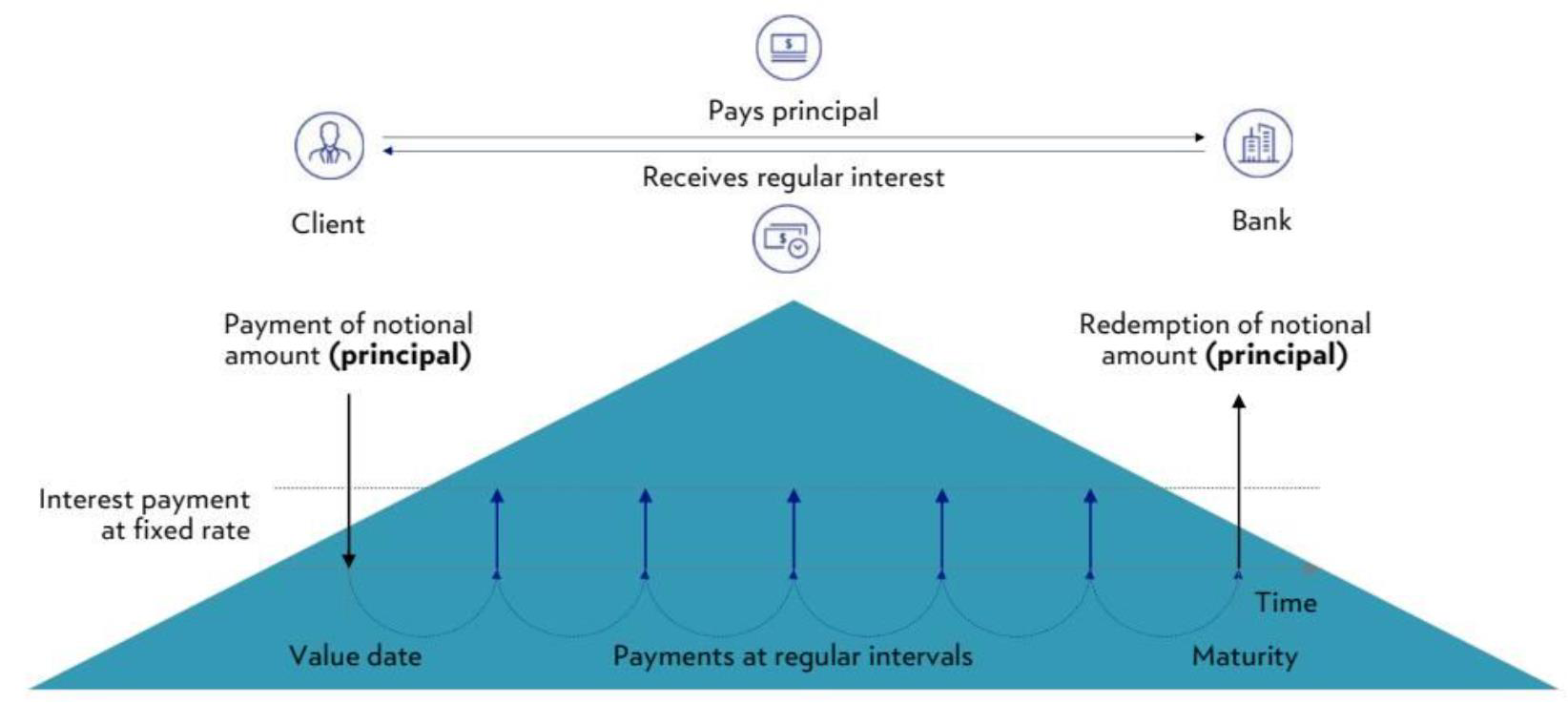
An example: A bond or note is a debt security, i.e. the investor lends money to a borrower for a defined period at a fixed interest rate. Interest is paid at regular intervals.
At value date, the investor lends a specific amount (including a premium or discount with respect to the face value). During the investment period, interest is paid at regular, predefined intervals. At maturity, the invested capital (principal) is paid back.
General types of bonds
Bond issuers are obliged to make payments (coupons) according to a predetermined schedule (coupon frequency), such as monthly, quarterly, semi-annually, or annually.
There are different types of bonds, depending on issue type and properties.
- Bonds: medium- to long-term debt obligations that are publicly traded (e.g. US Treasury bonds have maturities of up to 30 years).
- Bills: publicly traded short-term (max. 12 months) debt obligation (e.g. US Treasury T-Bills have a maturity of up to one year).
- Notes: privately placed medium-term obligations.
Beside these classical types, there are a number of other instruments with varying characteristics concerning the interest rate or cash-flow pattern:
- Straight bonds: fixed coupons set according to predefined rules (e.g. semi-annually). A straight bond is also known as a 'plain vanilla bond' or 'bullet bond'.
- Floating rate notes: variable coupons set according to predefined rules; also known as a 'floater' (e.g. quarterly EURIBOR +57.0000).
- Zero bonds: sold at a discount (price < 100%) that replaces/compensates for the interest payments.
- Perpetual bonds: have no maturity date.
- Amortised bonds: redemption (payment of principal) occurs regularly during the lifetime of the bond.
- Inflation-linked bonds: bonds are linked to a nationally recognised inflation measure.
Bonds are sometimes combined with option characteristics: bond-cum-warrants or convertible bonds. Bonds can be traded on regulated markets but are mostly over the counter.
Price and duration of a bond
The interest rate is an important risk factor when determining the price of a bond.
The price of a bond is calculated by discounting all future cash flows and is therefore dependent on: the volume of the cash flows (i.e. coupon rate) and their payment schedule; the time to maturity of the bond; the market interest rate used for discounting the cash flows.
If the bond is sold between two interest payment dates, the seller of the bond is entitled to also receive the accrued interest, i.e. the portion of the interest due since the last payment up to the selling date. The bond price without accrued interest is called the clean price as opposed to the dirty price, which includes the accrued interest.
The higher the market interest rate, the lower the price of the bond and vice versa. The duration is a key figure that determines the magnitude of the price change with a change in interest rates. Two important variants are used:
- Macaulay duration: weighted average time until cash flows are received, measured in years.
- modified duration: price change in percentage caused by an interest change of 1%.
Time to maturity of a bond
The investment risk of a bond increases with increasing time to maturity. The interest-rate risk goes up because of two factors:
- the probability of an increase in interest rates (and a corresponding fall of the bond price) rises with time.
- longer-term investments have a higher duration, so the same interest-rate increase has a higher effect on the price of long-term bonds than on the price of shorter-term bonds or notes.
Liquidity risk rises, since investors may not be willing to invest in the coupon rate when market conditions are more favourable.
Inflation and reinvestment risk rise: the probability that inflation diminishes the return increases with time. Likewise, the risk that it may not be possible to reinvest the return on equal conditions also rises.
These uncertainties are partially compensated if the issuer offers higher interest rates with more time to maturity.
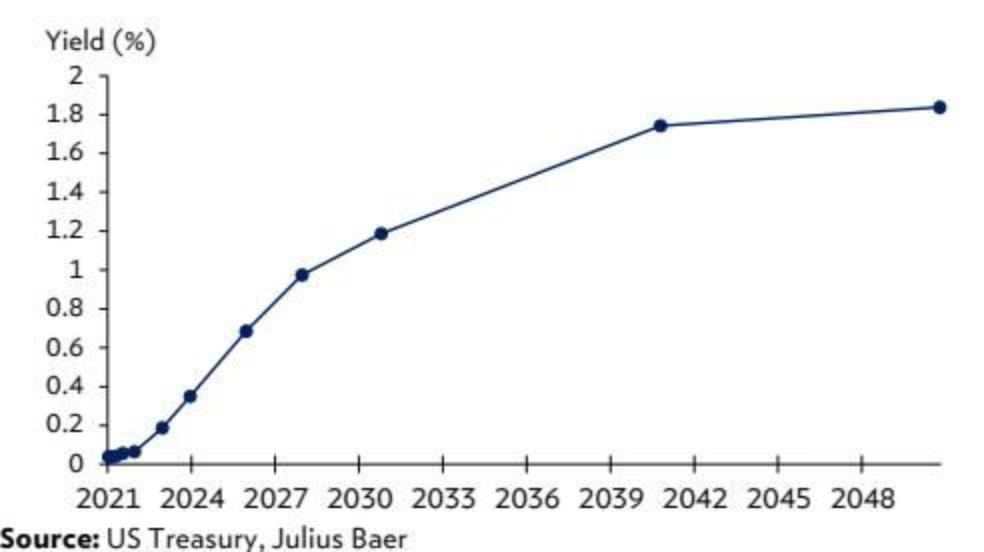
US Treasury yield curve
A yield curve is a line that plots yields (interest rates) of bonds having equal credit quality but differing maturity dates. The slope of the yield curve gives an idea of future interest-rate changes and economic activity.
Yield and return of bond
The total return from a bond investment is composed of the individual coupon payments plus any capital gain or loss on the nominal of the investment.
The return of a bond is measured by its yield, which is calculated as follows: yield = coupon/price of bond. Thus, if bond prices drop, the yield rises and vice versa.
The yield to maturity is the expected rate of return (excluding costs and taxes) of the investment when bought and held to maturity. It is, therefore, the given interest rate when the coupon rate, the maturity, and the (observed) bond price are known.
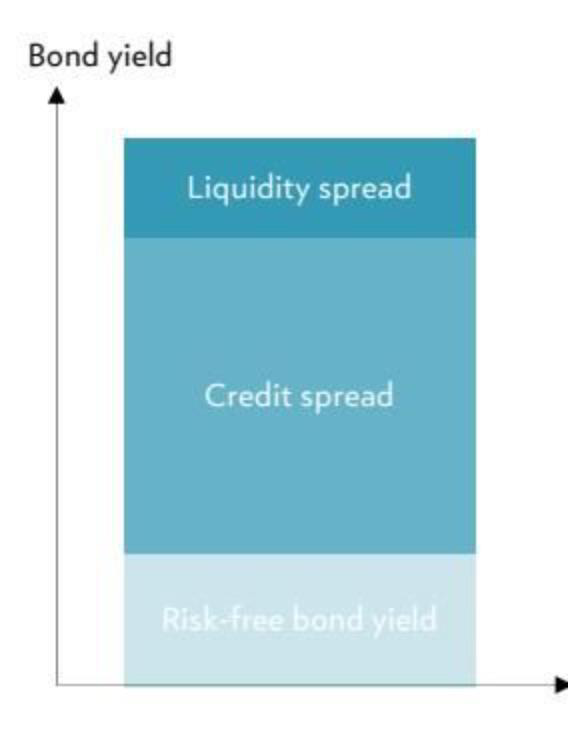
The yield of a bond can comprise the following:
- risk-free yield: the return the investor receives at any rate when investing in a bond that bears the lowest possible risks.
- credit spread: the compensation the investor receives when accepting a credit risk from the issuer.
- liquidity spread: the compensation the investor receives when investing in an instrument that is less liquid than others (e.g. shares).
Credit risk of the issuer
The more risk a bond investor takes on, the higher the potential return (interest offered by the issuer). Bonds are investments that target income generation through interest rather than price appreciation.
Therefore, from the investor's point of view, the quality of the debt is determined by the creditworthiness of the issuer. Creditworthiness expresses the likelihood that the issuer will repay the principal. The worst case is the probability of the issuer defaulting, i.e. becoming insolvent. It is the main consideration for the investor.
| Factor | Explanation |
|---|---|
| Issuer quality | Issuer quality measures the so-called 'probability of default' of the issuer. The probability that the issuer will not be able to fulfil its obligations. The insolvency can be total or partial and can include a default on coupon payments (e.g. defer payments) or a default on the face value of the investment (e.g. write-down). |
| Bond ranking | The ranking of debt determines the order of payment to investors if the issuer has need of liquidation. The higher the ranking, the higher the potential for a partial recovery of the investment. |
| Collateralisation | Debt is more secure if collateralised. The issuer has allocated securities or assets to cover the debt in case of default or is backed up by a guarantor. |
Quality of the issuer
The type of issuer determines the issuer's financial potential and thus the likelihood that it will fulfil its debt obligations. The lower the issuer's quality, the more risky is the investment and the higher the interest that is paid to the investor.
| Type of issuer | Explanation | Risk level |
|---|---|---|
| Supranational issuer | Supranational organisations may issue bonds that are guaranteed by member states. Supranational entities recuperate a wide range of top-rated accounts and are regarded as high investment grade. Examples are IMF (International Monetary Fund), EIB (European Investment Bank) | Lower risk (x) |
| Sovereign issuer | Debt obligations issued by a national government in international or national markets, usually in a global currency (such as USD, EUR, CHF, JPY). This usually signals high credit quality. Sovereign debt is issued by the state in terms of finances and economy | Lower risk (xx) |
| Sovereign agencies | Debt obligations issued by a government agency. The agency may explicitly be guaranteed by the government itself. An example is the Development Bank | Higher risk (x) |
| Corporate | Corporate bonds are issued by companies and usually regarded as higher risk than sovereign or supranational issuers. Corporate credit quality may depend on a company holding debt. Corporate bonds in the structure (e.g. holding-company versus operating companies and trusts) are regarded as being more risky | Higher risk (xx) |
The range of qualities/ratings varies widely within each group and there are always exceptions. For example, national governments differ strongly in the political and economic risks they carry, and consequently so does the quality of the bonds they issue.
Bond rankings
Non-financial issuers
Bonds have different claim levels in case the issuer defaults. The claim level determines how much money investors could possibly recover from their investment. Thus, the higher the claim level, the more secure is the bond (and the less interest is paid to the investor).
| Ranking | Explanation | Risk level |
|---|---|---|
| Senior secured bonds | Debt obligations that are paid before any other debt in case of insolvency. The specific pledge on company assets specifies the priority of these bonds | Lower risk (X) |
| Senior unsecured bonds | Debt obligations paid with priority before subordinated bonds | Lower risk (X) |
| Subordinated bonds | Bonds with a lower ranking than senior bonds. In case of insolvency, these are paid only after senior bonds have been paid. Subordinated bonds have a higher risk than senior bonds. However, subordinated bonds are, typically, still safer than ordinary shares | Lower risk (XX) |
| Hybrid securities | A security that has multiple components from both equity and debt capital. For example, convertible bonds and contingent capital instruments | Higher risk (X) |
| Ordinary shares | Shares that entitle the holder to an ordinary amount in dividends that may even be deferred, depending on the profits of the company. For example, equity | Higher risk (XX) |
Financial issuers
The claims on issuers that are financial institutions are regulated separately (1) from those of non-financial institutions. The main difference is that subordinated bonds of financial institutions have several sub-categories that specifically detail claims.
| Sub-ranking of financial subordinated bonds | Explanation | Risk level |
|---|---|---|
| Senior / non-preferred senior | Tier loss-absorbing capacity (TLAC) / Minimum requirement for own funds and eligible liabilities (MREL) obligations must have a residual maturity of at least one year. (The longer the maturity, the more 'gone concern' resources the issuer has to continue operating.) Contractual or structural subordination to senior unsecured liabilities, e.g. in bail-in, senior unsecured bonds junior to deposits or preferred senior bonds | Lower risk (X) |
| Tier 2 | Tier-2 bonds have a fixed maturity and pay coupons, unless financial institution comes into a gone-concern. The issuer may redeem them early, i.e. prior to the maturity. The value of the bonds may be written off resulting in a loss (e.g. in case of insolvency) or the bonds may convert to equity (PONV) if the issuer reaches its point of non-viability. | Higher risk (X) |
| Tier 1 | This is financial core capital available for absorbing losses on a 'going-concern' basis. Tier 1 is non-redeemable (i.e. perpetual) with no fixed maturity. Financial institutions can cancel coupons without triggering a default. The bond generally comes with perpetual maturity, deferrable, non-cumulative coupons and no fixed redemption date. The value of the bonds may be partially or permanently written off, or the bonds may convert to equity if the issuer reaches its point of non-viability (PONV) (falls below Common Equity Tier 1 ratio threshold of the issuer). | Higher risk (XX) |
(1) Banks and other qualifying investment firms established or holding branches within the EU are required to issue minimum levels of specifically identified capital (titled "Subordinated Eligible Liabilities" or SELs) containing clauses identifying they can be subject to temporary or permanent cancellation of either coupon and permanent write down of capital (and in some cases convertibility to equity) to support an investor led bail. These features are triggered independently at government mandated thresholds, to ensure a "managed wind-down" minimising the risk to depositors or contagion to the wider financial system.
Bond ratings (1/2)
Creditworthiness is measured in ratings. There are three major companies that provide the framework and evaluate and publish debt obligation ratings: Moody's, Fitch, and Standard & Poor's. The ratings provide an important source of information about the quality of the investment.
The aim of the rating is to measure consistently the credit risk associated with investing in a specific company, institution, instrument, or market.
Ratings are a measure of the issuer's ability and willingness to repay debt. It is not, in any case, a recommendation to buy/sell/hold any investment.
- High-yield bonds refer to bonds that are generally below investment grade (below BBB- or Baa3 by established credit rating agencies) or are unrated. In general, the denomination 'high-yield' is equivalent to a 'speculative', 'non-investment-grade', or 'junk' rating.
- All ratings are divided into two broad categories: investment grade and non-investment (speculative) grade.
Bond ratings (2/2)
| Bond rating | Moody's | Standard & Poor's | Fitch Ratings | Credit rating definition |
|---|---|---|---|---|
| Investment grade | Aaa | AAA | AAA | Obligations rated Aaa are judged to be of the highest quality, with minimal credit risk. |
| Investment grade | Aa1 / Aa2 / Aa3 | AA+ / AA / AA- | AA+ / AA / AA- | Obligations rated Aa are judged to be of high quality and are subject to very low credit risk. |
| Investment grade | A1 / A2 / A3 | A+ / A / A- | A+ / A / A- | Obligations rated A are considered upper-medium grade and are subject to low credit risk. |
| Investment grade | Baa1 / Baa2 / Baa3 | BBB+ / BBB / BBB- | BBB+ / BBB / BBB- | Obligations rated Baa are subject to moderate credit risk. They are considered medium-grade and as such may possess certain speculative characteristics. |
| Non-investment grade (high-yield) | Ba1 / Ba2 / Ba3 | BB+ / BB / BB- | BB+ / BB / BB- | Obligations rated Ba are judged to have speculative elements and are subject to substantial credit risk. |
| Non-investment grade (high-yield) | B1 / B2 / B3 | B+ / B / B- | B+ / B / B- | Obligations rated B are considered speculative and are subject to high credit risk. |
| Non-investment grade (high-yield) | Caa1 / Caa2 / Caa3 | CCC+ / CCC / CCC- | CCC+ / CCC / CCC- | Obligations rated Caa are judged to be of poor standing and are subject to very high credit risk. |
| Non-investment grade (high-yield) | Ca | CC | CC | Obligations rated Ca are highly speculative and are likely in, or very near, default, with some prospect of recovery of principal and interest. |
| Non-investment grade (high-yield) | C | C / D | C | Obligations rated C are the lowest-rated class of bonds and are typically in default, with little prospect for recovery of principal or interest. |
| Non-investment grade (high-yield) | Unrated | Unrated |
Zero bonds
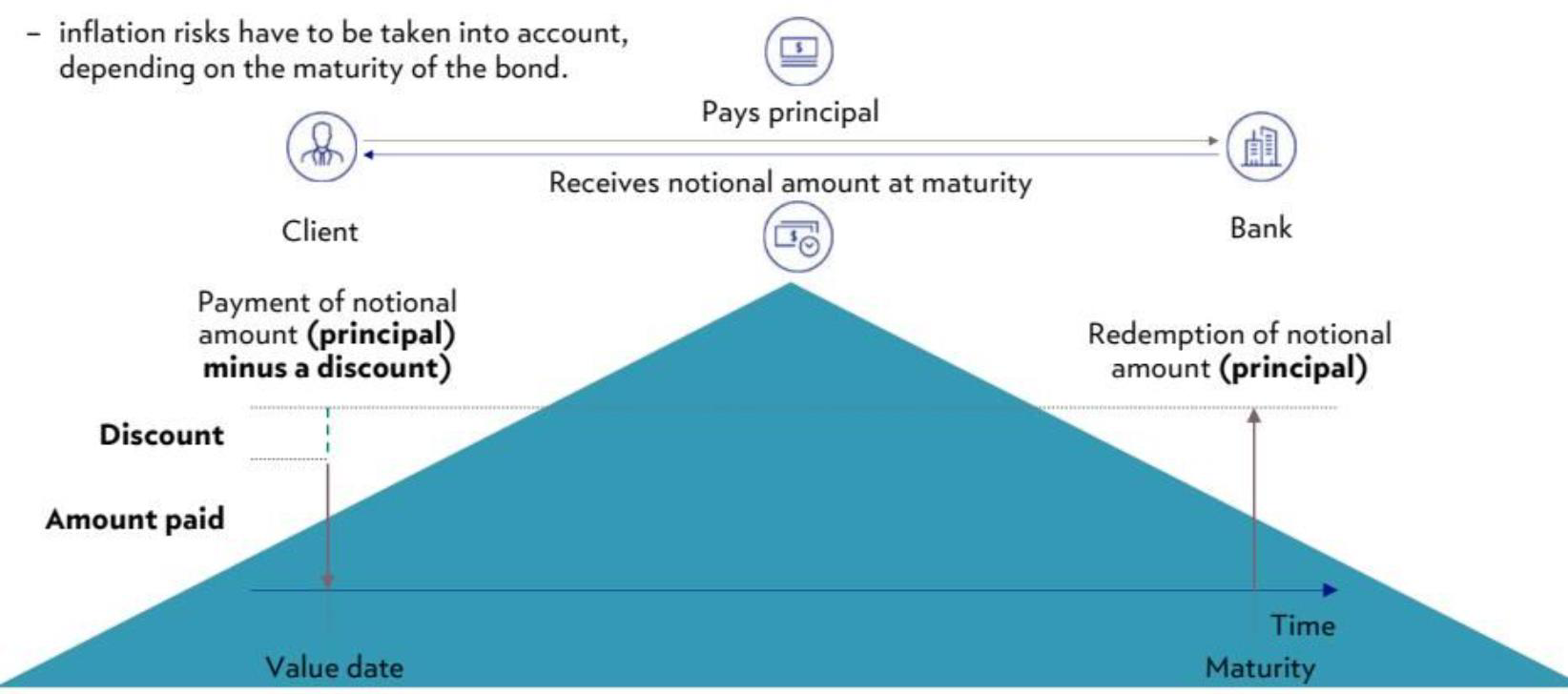
Zero bonds (or zero-coupon bonds) are a special kind of bond instrument.
Interest payments are not made at regular intervals but are calculated in a discount that is deducted from the principal upon issue of the bond. The discount represents the yield of the bond.
Risks and rewards are similar to those of normal bonds. However, credit risk tends to be higher with zero bonds, since the investment only pays off at maturity.
Bonds with variable coupons
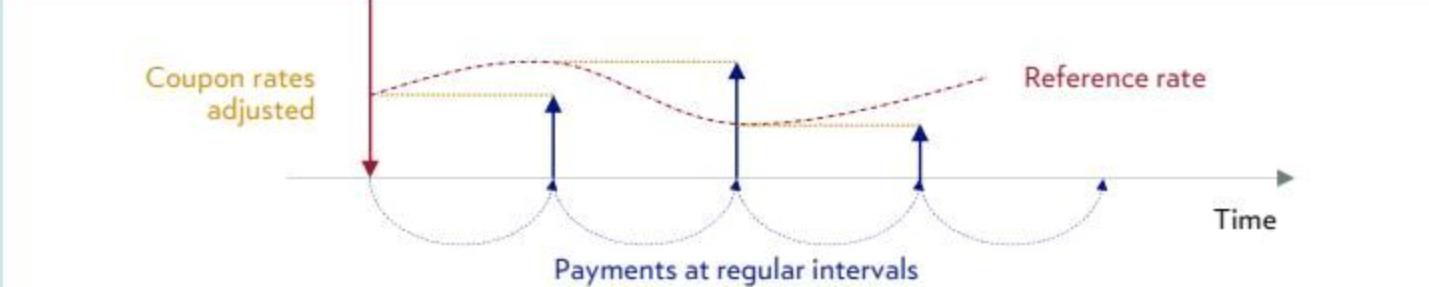
Plain vanilla bonds pay a fixed coupon rate on a fixed nominal value. Some special bond types have variable coupon rates. As a result, the coupon payment will change even if the nominal is fixed. In some jurisdictions, this type of payment is also known as variable interest payment.
Floating rate notes and step-up / step-down
| Type | Explanation |
|---|---|
| Floating rate notes | Bonds whose coupon rate is linked to a reference interest rate, e.g. LIBOR. Coupon rates are reset using a predetermined schedule (at preset dates). |
| Step-up / step-down bonds | Step-up / -down bonds offer varying but predetermined coupon rates. Step-down products are rarer and offer a step-down if certain conditions are met by the issuer, e.g. if a better credit rating is achieved. Step-up coupons are sometimes linked to perpetual bonds, raising the coupon if the issuer does not call. This is an incentive to the issuer to redeem the debt obligations. |
Bonds with variable notional amount (1/2)
Amortises and perpetual bonds
| Type | Explanation |
|---|---|
| Amortises | Amortises redeem their notional amount in instalments instead of a single payment at maturity. As a result, the coupon payment decreases as the nominal value of the bond falls. |
| Perpetual bonds | Perpetuals are bonds without maturity, i.e. the capital invested is never redeemed and coupons are paid 'forever'. They therefore have characteristics similar to equity (shares). Perpetual bonds are usually callable by the issuer after a minimum investment period. Perpetual bonds are often issued by banks as subordinated debt that is included in tier-1 capital. |
Bonds with variable notional amount (2/2)
Inflation-linked bonds
- While the coupon rate for a vanilla bond is fixed, the purchasing power of the payment will fluctuate according to inflation. The risk that inflation will diminish the purchasing power of the return of a vanilla bond increases with the time to maturity.
- Inflation-linked bonds adjust the nominal value according to an index reflecting inflation (e.g. consumer price index). As a result, the coupon payments will vary but will compensate for the inflation.
- The most liquid instruments are Treasury-inflation protected securities (TIPS), a type of US Treasury security.
- Example: nominal value USD 1,000, 1.7% inflation per year. A vanilla bond at 5% and an inflation-linked bond at 3% will deliver similar receipts (principal + interest) of USD 1,500 versus USD 1,513.
- At maturity, the vanilla bond pays a principal of USD 1,000 with a purchasing power of USD 844.87.
- At maturity, the inflation-linked bond pays a principal of USD 1,183.61 with a purchasing power of USD 1,000.
| Index | Vanilla bond – Principal (Nominal value) | Vanilla bond – Principal (Real value) | Vanilla bond – Coupon (Nominal value) | Vanilla bond – Coupon (Real value) | Inflation-linked bond – Principal (Nominal value) | Inflation-linked bond – Principal (Real value) | Inflation-linked bond – Coupon (Nominal value) | |
|---|---|---|---|---|---|---|---|---|
| At issue | 100 | 1,000 | 1,000 | 50 | 49.16 | 1,017.00 | 1,000 | 30.51 |
| Year 1 | 101.70 | 1,000 | 983.28 | 50 | 49.16 | 1,017.00 | 1,000 | 30.51 |
| Year 2 | 103.43 | 1,000 | 966.85 | 50 | 48.34 | 1,034.29 | 1,000 | 31.03 |
| Year 3 | 105.19 | 1,000 | 950.69 | 50 | 47.53 | 1,051.87 | 1,000 | 31.56 |
| Year 4 | 106.98 | 1,000 | 934.79 | 50 | 46.74 | 1,069.75 | 1,000 | 32.09 |
| Year 5 | 108.79 | 1,000 | 919.17 | 50 | 45.96 | 1,087.94 | 1,000 | 32.64 |
| Year 6 | 110.64 | 1,000 | 903.80 | 50 | 45.19 | 1,106.43 | 1,000 | 33.19 |
| Year 7 | 112.52 | 1,000 | 888.70 | 50 | 44.43 | 1,125.24 | 1,000 | 33.76 |
| Year 8 | 114.44 | 1,000 | 873.84 | 50 | 43.69 | 1,144.37 | 1,000 | 34.33 |
| Year 9 | 116.38 | 1,000 | 859.23 | 50 | 42.96 | 1,163.83 | 1,000 | 34.91 |
| Year 10 | 118.36 | 1,000 | 844.87 | 50 | 42.24 | 1,183.61 | 1,000 | 35.51 |
Other bond features
| Feature | Explanation |
|---|---|
| ISIN | Bonds are normally assigned an ISIN (International Securities Identification Number), which is a 12-character code that uniquely identifies a security. |
| 144A | 144A is a rule of the Securities and Exchange Commission (SEC) in the US. Bonds with the 144A rule are allowed to be bought and held by qualified institutional investors only, which are generally large institutional investors. |
| REGS | A bond with Regulation S (REGS) is offered to non-US residents under an exception to US securities laws. Non-residents do not get the same legal protection with new issues as US clients do. REGS bonds are available for private investors. |
| HKEx Chapter 37 | Applicable to bond listings on Hong Kong Exchanges and Clearing Limited (HKEx) only. The debt is issued and distributed to Hong Kong professional investors only. |
| Denomination | The denomination is the face value of a financial instrument. For bonds, it is usually USD 1,000 or multiples thereof (in the case of a USD bond). |
| Change of control | Change of control (CoC) means that the ownership of the issuer is shifting from one party to another. In this event, bonds with a CoC clause will be redeemed at a predefined price. |
| Make whole | A 'make whole' allows the issuer to redeem a bond before maturity. However, the borrower has to pay a 'fine' in the form of an additional payment that is based on a predefined calculation. |
| Pay in kind (PIK) | A PIK bond allows the issuer to pay interest with additional bonds rather than cash. PIK bonds are speculative bonds, as the issuer is creating more debt, implying that the borrower is unable to pay the interest in cash. |
| Special purpose vehicle (SPV) with keepwell structure | A contract between a parent company and its subsidiary to maintain solvency and financial backing throughout the term set in the agreement. This is a method by which subsidiary companies may increase the creditworthiness of debt instruments and corporate borrowing. |
| Lock-in period | The period of time in which a loan may not be prepaid and when a lender will guarantee a certain interest rate on a loan to be extended by it in the future. |
| Callable | The bond can be redeemed by the issuer prior to its maturity. |
| Puttable | It allows the holder to demand early repayment of the principal from the issuer or a third party acting as an agent for the issuer, and the repurchase price is set at the time of issue. |
| Discretionary deferrable cumulative coupon | The issuer has the discretion to pay a coupon. Deferred cumulative coupons are interest that has not been paid but is accumulated and paid later, most of the time cash compounding. |
| Discretionary deferrable non-cumulative coupon | The issuer has the discretion to pay a coupon. Deferred non-cumulative coupons will be cancelled and hence not paid. |
| Extended maturity | A bond that includes the option to lengthen its maturity date. |
| Deferred interest payment | A bond that pays interest at a later date instead of in periodic increments. |
Important legal information
Legal entity
U Wealth SA – 8C avenue de Champel, 1206 Genève, Suisse. Supervised by FINMA (Swiss Financial Market Supervisory Authority).
Educational and Informational Disclaimer
Educational and Informational Disclaimer: This content is provided for informational and educational purposes only. It does not constitute marketing material, nor is it the result of independent financial/investment research. It has not been prepared in accordance with the legal requirements designed to promote the independence of financial research and is not subject to any prohibition on dealing ahead of the dissemination of such research. The content has been prepared by U Wealth SA, which is authorised and regulated by FINMA (Swiss Financial Market Supervisory Authority). The information may be updated irregularly or in response to significant developments.
Informational Purposes Only
Informational Purposes Only: All information and opinions were valid at the time of writing and are subject to change without notice. This document is provided for informational purposes only and does not constitute legal, tax, accounting or investment advice, nor does it constitute an offer or invitation to buy or sell any financial instrument. Opinions expressed herein reflect the current views of the authors but not necessarily those of U Wealth SA as a whole. While the information is believed to be accurate and sourced from reliable providers, U Wealth SA makes no warranty as to its accuracy, completeness, or timeliness. U Wealth SA accepts no liability, to the extent permitted by law, for any direct or indirect damages or losses arising from the use of this material or any decisions taken based on it.
Suitability & Professional Advice
Suitability & Professional Advice: Investments mentioned may not be suitable for all investors. Each investor should consider the suitability of an investment to their personal circumstances and objectives and consult their professional advisor before making any financial decision. This content does not constitute a personal recommendation and does not take into account your personal investment profile or financial situation.
Sustainability / ESG
Sustainability / ESG: This material does not necessarily adhere to ESG regulations or standards that may apply in other jurisdictions. For details on ESG criteria and any potential impact on financial return or investment eligibility, please contact U Wealth directly.
General Risks
General Risks: The value of and income from investments may rise or fall, and investors may not recover the amount invested. Financial instruments may be exposed to various risks, including but not limited to market, credit, political, and currency risks. Past performance and simulated returns are not reliable indicators of future performance. Structured products mentioned do not represent collective investment schemes under Swiss law and are not supervised by FINMA as such. Investors do not benefit from the specific protections provided by the Swiss Federal Act on Collective Investment Schemes.
Third-Party Data
Third-Party Data: Some information may originate from third-party providers such as credit rating agencies, financial data sources, or ESG data platforms. U Wealth SA does not guarantee the accuracy or completeness of this data and declines any liability related to its use.
Restricted Distribution
Restricted Distribution: This content is intended solely for recipients located in Switzerland and is not directed to any person or entity in any jurisdiction where its distribution would be contrary to local laws or regulations. This document may not be reproduced or distributed without prior written consent from U Wealth SA.
United States
UNITED STATES: NEITHER THIS CONTENT NOR ANY COPY THEREOF MAY BE SENT, TAKEN INTO OR DISTRIBUTED IN THE UNITED STATES OR TO ANY US PERSON. © U Wealth, 2025
Contact information
contact@uwealth.ch | +41 (0)22 545 51 40