
Educational Pack · 07
Forwards and Swaps
Source PDF: GUIDE-TO-UNDERSTANDING-ASSET-CLASSES-FORWARDS-AND-SWAPS.pdf
U Wealth : Your partner in mastering financial instruments. We want you to feel comfortable making suitable investment decisions based on knowledge of the opportunities and risks of given financial instruments. — September 2026
What are forwards and swaps?
Forwards and swaps are derivative instruments.
A derivative is a security whose price is dependent on, or derived from, one or more underlying assets. The derivative itself is merely a contract between two or more parties.
There is a crucial difference between a direct investment and an investment in a derivative:
- When directly investing in a financial instrument such as a stock or a bond, the investor participates directly in its risks, gains, and losses.
- When investing in a derivative, the investor invests in a contract, note, unit, or certificate. This adds specific characteristics, risks, obligations, and/or rights to the assets on which the derivative is based.
- Forwards allow the investor to buy/sell an asset on a specific date in the future at a specific price.
- Swaps are agreements between two parties to purchase and sell identical amounts of an asset at two different dates (usually spot to forward).
- Both forwards and swaps are private agreements between the buyer and the counterparty.
- The most common underlying assets of forwards and swaps are currencies or precious metal currencies.
Advantages / Disadvantages
Advantages
- Cost efficiency: by leverage — the gross amount invested is smaller than trading the individual underlyings.
- Hedging instruments: losses can be limited by long options (buying a right).
- Flexibility: ability to trade a wide range of underlyings and to lock in prices.
Disadvantages
- Not standardized: forwards and swaps are not standardized contracts such as futures and access to the forward market is therefore limited.
- Risk of losses: if used with a speculative intention, strategies such as leveraging and short selling bear the risk of overproportional or even unlimited losses.
What are forwards and swaps? — Definitions
- A forward is a customised derivative contract obligating counterparties to buy (receive) or sell (deliver) an asset at a specified price on a future date.
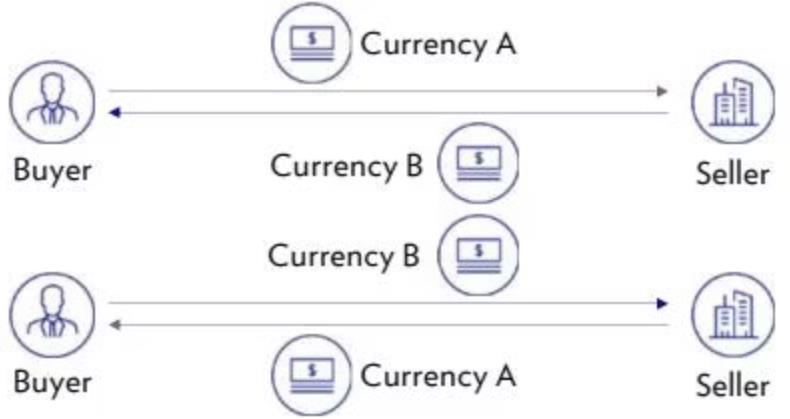
- A swap is an agreement between two parties to exchange cash flows during a set period of time. Swap contracts have two legs — a spot transaction and a forward transaction — for the same quantity. Therefore, they offset each other.
- Both forward and swap contracts can be used for hedging or speculation, although their non-standardised nature makes them particularly useful for hedging.
- In forex markets, forwards are used to exploit arbitrage opportunities at the cost of carrying different currencies.
Important risks to consider
Counterparty risk
The unregulated nature of the forwards market means that it may be difficult to assess the creditworthiness of the counterparty in a worst-case scenario.
Settlement risk
Forwards are only settled on the settlement date and are not marked-to-market like futures.
Over-the-counter only
Forwards and swaps are unregulated and non-standardised contracts that can be acquired only through the over-the-counter market.
What to expect from forwards and swaps
| Investment horizon | Income expectation | Market expectation |
|---|---|---|
| Shorter term · Medium term | Capital gain | Increasing · Decreasing |
General types of forward products
There are two major types of transactions.
Spot transactions
Spot transactions are transactions based on the foreign exchange rates currently available. They include: currencies, precious metals.
Forward products
Forward products are transactions that are settled in the future. They include: outright, other forward products, such as options. These types of transactions carry different risks and require additional knowledge of derivative instruments.
| Category | Items |
|---|---|
| Over-the-counter | Forwards · Swaps · Over-the-counter options |
| Exchange-traded | Futures · Options |
How forwards and swaps work
| Example | Characteristics | Motivation |
|---|---|---|
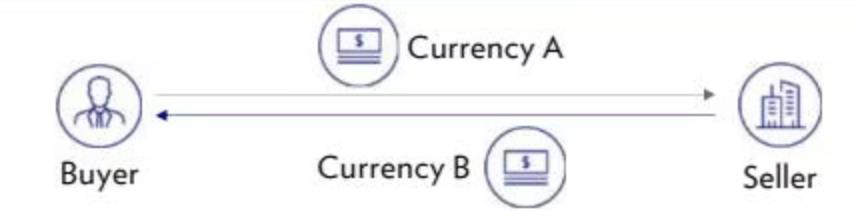
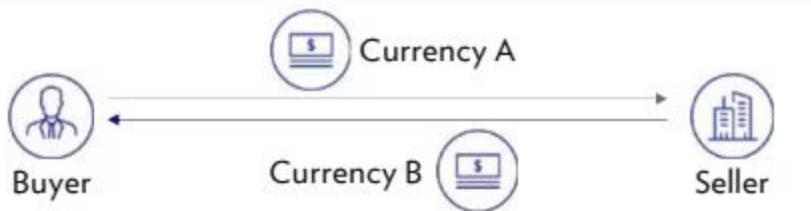
| Spot — today | Spot trades are usually settled within two working days. | Direct need for currency |
| Forward — future date | Agreement to buy/sell in the future at a price fixed today. | Speculation · Hedging |
| Swap — today (spot leg) and future date | Agreement to purchase a defined amount of a currency today with the agreement to sell the same amount of this currency again at a future date. | Speculation · Hedging |
Differences between forwards and futures
Forwards are similar to futures with regards to their purpose: they allow the investor to buy/sell an asset on a specific date at a specific price.
The major difference is that futures are standardised exchange-traded contracts, while forwards are basically private agreements between two parties that are less rigid in terms and conditions.
Settlement and delivery differ
| Forwards | Futures |
|---|---|
| Forwards have one settlement date and are cleared/settled on that date only. | Changes in market price are cleared daily. Settlement can occur on a range of dates. |
Due to these differences, futures and forwards differ in their risk exposure
| Counterparty risk | Liquidity risk |
|---|---|
| Since forwards are agreements that are traded over the counter, the counterparty risk tends to be higher than in the case of futures and requires the respective carefulness in the selection of the investment. | Depending on the type of contract, forwards tend to have higher liquidity risks. |
Non-deliverable forwards
Forwards on currencies are often used as a hedge against the volatility of currency exchange rates.
Non-deliverable forwards are currency forwards that involve:
- one freely obtainable currency (e.g. USD) and,
- a currency that is not freely obtainable, thinly traded, or on which forward trades have been banned (hence are non-deliverable).
The trade is defined by:
- a notional amount
- the non-deliverable forward rate: actually the estimated forward rate of the non-deliverable currency
- fixing and settlement dates.
The non-deliverable forward is traded over the counter and always settled in cash as the difference between the actual spot rate at the fixing date and the non-deliverable forward rate.
Important legal information
U Wealth SA – 8C avenue de Champel, 1206 Genève, Suisse. Supervised by FINMA (Swiss Financial Market Supervisory Authority). This content is provided for informational and educational purposes only. It does not constitute marketing material, nor is it the result of independent financial/investment research. It has not been prepared in accordance with the legal requirements designed to promote the independence of financial research and is not subject to any prohibition on dealing ahead of the dissemination of such research. The content has been prepared by U Wealth SA, which is authorised and regulated by FINMA (Swiss Financial Market Supervisory Authority). The information may be updated irregularly or in response to significant developments.
Informational purposes only
All information and opinions were valid at the time of writing and are subject to change without notice. This document is provided for informational purposes only and does not constitute legal, tax, accounting or investment advice, nor does it constitute an offer or invitation to buy or sell any financial instrument. Opinions expressed herein reflect the current views of the authors but not necessarily those of U Wealth SA as a whole. While the information is believed to be accurate and sourced from reliable providers, U Wealth SA makes no warranty as to its accuracy, completeness, or timeliness. U Wealth SA accepts no liability, to the extent permitted by law, for any direct or indirect damages or losses arising from the use of this material or any decisions taken based on it.
Suitability & professional advice
Investments mentioned may not be suitable for all investors. Each investor should consider the suitability of an investment to their personal circumstances and objectives and consult their professional advisor before making any financial decision. This content does not constitute a personal recommendation and does not take into account your personal investment profile or financial situation.
Sustainability / ESG
This material does not necessarily adhere to ESG regulations or standards that may apply in other jurisdictions. For details on ESG criteria and any potential impact on financial return or investment eligibility, please contact U Wealth directly.
General risks
The value of and income from investments may rise or fall, and investors may not recover the amount invested. Financial instruments may be exposed to various risks, including but not limited to market, credit, political, and currency risks. Past performance and simulated returns are not reliable indicators of future performance. Structured products mentioned do not represent collective investment schemes under Swiss law and are not supervised by FINMA as such. Investors do not benefit from the specific protections provided by the Swiss Federal Act on Collective Investment Schemes.
Third-party data
Some information may originate from third-party providers such as credit rating agencies, financial data sources, or ESG data platforms. U Wealth SA does not guarantee the accuracy or completeness of this data and declines any liability related to its use.
Restricted distribution
This content is intended solely for recipients located in Switzerland and is not directed to any person or entity in any jurisdiction where its distribution would be contrary to local laws or regulations. This document may not be reproduced or distributed without prior written consent from U Wealth SA. UNITED STATES: NEITHER THIS CONTENT NOR ANY COPY THEREOF MAY BE SENT, TAKEN INTO OR DISTRIBUTED IN THE UNITED STATES OR TO ANY US PERSON. © U Wealth, 2025
Contact information
contact@uwealth.ch | +41 (0)22 545 51 40