
Educational Pack · 06
Foreign Exchange
Source PDF: GUIDE-TO-UNDERSTANDING-ASSET-CLASSES-FOREIGN-EXCHANGE.pdf
U Wealth : Your partner in mastering financial instruments. We want you to feel comfortable making suitable investment decisions based on knowledge of the opportunities and risks of given financial instruments. — September 2026
What is foreign exchange?
Foreign exchange involves the exchange of two different currencies.
Certain precious metals (e.g. gold) share similar properties to currencies (e.g. availability of forward and derivative contracts), and are included in foreign exchange markets and traded in the same way.
Advantages / Disadvantages
Advantages
- Liquidity and availability: the foreign exchange market is the biggest liquid market in the world; it is open 24 hours a day.
- Volumes: high volumes can be traded without influencing prices.
- Low costs/spreads.
- Low margin: it has low margin requirements and fewer quantitative limitations compared to futures.
- Hedging: forward markets may be used to hedge against currency risk.
Disadvantages
- Constant attention: due to availability and dynamics, constant attention is needed.
- Leverage risks: leverage and margin (optional) maximise profits but also potential losses.
- Different costs: there are different costs/spreads for retail and wholesale clients.
- Central bank intervention: central banks can intervene in the market.
- Volatility: foreign exchange rates can be volatile.
Important risks to consider
Spot and outright transactions
Market risks: Foreign Exchange Rates may change as a result of many factors. These include: forces of supply and demand, political and economic changes in the currency's home country (including changes in monetary policy).
Credit and liquidity risks
Foreign exchange trading is 'over the counter', based on the fulfillment of agreements about a currency rate in the future. This introduces counterparty risks.
- Counterparty credit risk: the ability of the counterparty to fulfill its obligations is an important consideration. For example, in foreign exchange transactions on U Wealth, U Wealth is the relevant counterparty and not a third-party bank.
- Liquidity risk: your rights might be closed out before the settlement date using a counter-deal. The liquidity of foreign exchange contracts with longer maturities is lower than with shorter ones. During the life of the contract, the collateral will be blocked on the account.
What to expect from spot and outright transactions?
Investment horizon
- Short term (up to 12 months)
Income expectation
- Capital gain
Market expectation
- Increasing
- Decreasing
- High volatility
- Sideways
Important to know before making spot and outright
Maximum gain
Unlimited – the difference between market value at buying/selling.
Maximum loss
There is a risk of unlimited loss.
Profit/loss
Profit and loss are not predictable. The return behaves linearly with the changing exchange rates (adjusted for interest rates over time). When investing, the following points should be taken into consideration.
- Foreign exchange rates can be highly volatile and markets are directly exposed to country risk. Corresponding knowledge of the political and economic situation of the currency's home country is helpful.
- Trading can involve significant leverage. This should be weighed against one's financial abilities. A clear idea of the risks one is willing to take is indispensable.
- Depending on the investment objectives, spot markets/outrights are only one way of entering foreign exchange markets. There are other investment products too.
How foreign exchange works
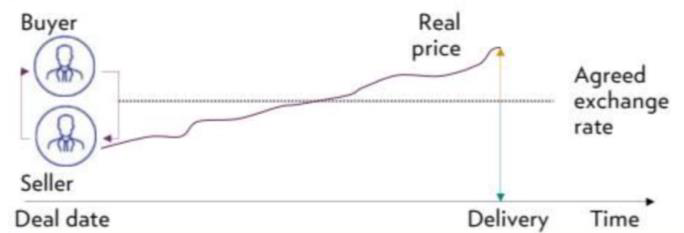
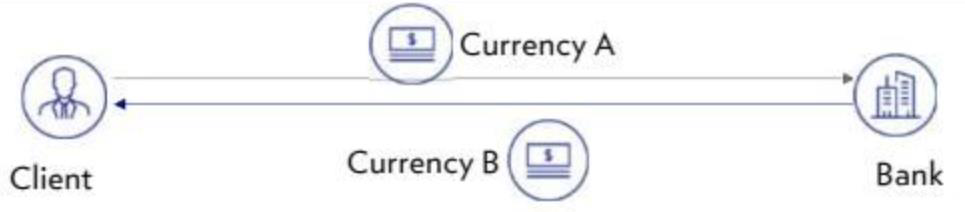
| Example | Characteristics | Motivation |
|---|---|---|
| Interbank market — Buying bank ↔ Currency A → Currency B → Selling bank | Spot trades are usually settled within two working days. | Direct need for currency |
| Forward market — Buyer ↔ Seller; deal date → delivery time; real price curve vs agreed exchange rate | Agreement to buy/sell in the future at a price fixed today | Speculation |
| Banking retail business — Client ↔ Currency A → Currency B → Bank | Retail quantities · Other margins apply than on the interbank market. | Direct need for currency · Hedging · Speculation |
General types of foreign exchange transactions
There are two major types of foreign exchange transactions.
Spot transactions
Spot transactions are transactions based on the foreign exchange rates currently available. These include: currencies, precious metals.
Forward products
Forward products are transactions that are settled in the future. These include: outright, other forward products, such as options.
| Foreign exchange spot transactions | Forward products — over-the-counter | Forward products — exchange-traded |
|---|---|---|
| Currencies · Banknotes and precious metals | Outrights · Swaps · Over-the-counter options | Futures · Options · Warrants |
Properties of foreign exchange markets
The foreign exchange market
Is the largest available financial market worldwide.
- Liquidity and traded volumes are extremely high.
- Volatility can be substantial.
- The only market in the world that is open 24 hours a day. Recently, however, the market in cryptocurrencies has grown dramatically and is open 24 hours a day, as well as seven days a week.
- For reasons of demand, liquidity, and availability, precious metals and precious metal accounts are included in the foreign exchange market.
The foreign exchange trades
Foreign exchange trades presuppose that currencies are freely tradeable. This is not the case for all currencies. The currency traffic is regulated by the authorities, and the way they manage exchange rates is called a 'regime'. Examples of exchange rate regimes are: free float: the exchange rate is determined by supply and demand, and may be managed by the central banks to avoid excessive appreciation/depreciation. pegged: fixed to a specific value or floating within a band.
For the investor, this may mean that certain currencies are not freely available or are traded at exchange rates that do not reflect actual market conditions. Policies may be changed by the authorities at any time.
Foreign exchange rates and foreign exchange forward rates
An exchange rate ('forex' rate) is the rate at which one currency can be converted into another.
This depends on a variety of factors, including:
- interest and inflation rates
- political stability
- transparency of the country's economic and political decisions
- general economic welfare.
In foreign exchange transactions, there are two types of exchange rates.
Spot rates
The exchange rate for immediate settlement of the transaction.
Forward rates
The exchange rate applicable at a certain date in the future. Forward rates are based on the spot rate, adjusted by the difference in interest rates between the two currencies involved.
Spot and outright transactions
Spot and outright transactions are two important types of foreign exchange transactions. The following table shows their most important characteristics.
| Spot transactions | Outright transactions (forward transactions) |
|---|---|
| A spot transaction is the purchase or sale of a foreign currency at the current today available rate (spot rate). | An outright rate is an agreement for a currency exchange with a maturity in the future. |
| Settlement is done on the second or third working day after conclusion of the trade. | Foreign currency can be bought or sold through outright. |
| The amount can be fixed beforehand. | |
| The maturity may be from three working days in the future to any date up to five years (commonly one-, two-, three-, six-, or twelve-month maturities). | |
| The rate is negotiated directly between the client and the bank at the deal date. The bank executes the trade on its own account. | |
| The contract may not be terminated early. However, a transaction can be cleared by settling a counter-transaction on the same maturity date. | |
| Banks demand a margin as a collateral. |
Returns, leverage, margins, and spreads
Returns
Returns on the foreign exchange market are realised by fluctuations in the exchange rate with time, adjusted for interest-rate differentials.
Costs
The costs of the trade are mainly the bid/ask spread. This spread is typically lower for foreign exchange than for other financial instruments and may depend on the volume of the trade.
Bid/ask spread: orders (interests) to buy or to sell are left in the market and investors can trade on them. The best bid will be the highest available price at which an investor can sell. The best offer will be the lowest price that buyers can find among orders (interests) left in the market by sellers. The difference is called the 'bid/ask spread'.
Margins and leverage
Currencies on the spot market require full coverage of the nominal value. Outright transactions are usually not exchanged at the face value; instead, so-called margin and financial leverage apply.
- When executing a trade, an initial deposit (a margin) is required that is usually lower than the nominal value of the trade.
- The margin can be as low as 10% of the face value. The possibility to trade high volumes based on a minimum initial amount is called financial leverage. For less liquid or more volatile currency (or precious metal) pairs, higher margins will be applied. Most of the liquidity is available for tenors of up to one year; less liquid currency or precious metal pairs might be available for shorter tenors only.
- Margin requirements may change according to exchange rate fluctuations. This may generate the need for further collateral to be added to the initial margin provided (a so-called 'margin call').
- Leverage maximises not only potential profits but also potential losses. It contributes very significantly to the risks involved.
Important legal information
U Wealth SA – 8C avenue de Champel, 1206 Genève, Suisse. Supervised by FINMA (Swiss Financial Market Supervisory Authority). This content is provided for informational and educational purposes only. It does not constitute marketing material, nor is it the result of independent financial/investment research. It has not been prepared in accordance with the legal requirements designed to promote the independence of financial research and is not subject to any prohibition on dealing ahead of the dissemination of such research.
Informational purposes only
All information and opinions were valid at the time of writing and are subject to change without notice. This document is provided for informational purposes only and does not constitute legal, tax, accounting or investment advice, nor does it constitute an offer or invitation to buy or sell any financial instrument. Opinions expressed herein reflect the current views of the authors but not necessarily those of U Wealth SA as a whole. While the information is believed to be accurate and sourced from reliable providers, U Wealth SA makes no warranty as to its accuracy, completeness, or timeliness. U Wealth SA accepts no liability, to the extent permitted by law, for any direct or indirect damages or losses arising from the use of this material or any decisions taken based on it.
Suitability & professional advice
Investments mentioned may not be suitable for all investors. Each investor should consider the suitability of an investment to their personal circumstances and objectives and consult their professional advisor before making any financial decision. This content does not constitute a personal recommendation and does not take into account your personal investment profile or financial situation.
Sustainability / ESG
This material does not necessarily adhere to ESG regulations or standards that may apply in other jurisdictions. For details on ESG criteria and any potential impact on financial return or investment eligibility, please contact U Wealth directly.
General risks
The value of and income from investments may rise or fall, and investors may not recover the amount invested. Financial instruments may be exposed to various risks, including but not limited to market, credit, political, and currency risks. Past performance and simulated returns are not reliable indicators of future performance. Structured products mentioned do not represent collective investment schemes under Swiss law and are not supervised by FINMA as such. Investors do not benefit from the specific protections provided by the Swiss Federal Act on Collective Investment Schemes.
Third-party data
Some information may originate from third-party providers such as credit rating agencies, financial data sources, or ESG data platforms. U Wealth SA does not guarantee the accuracy or completeness of this data and declines any liability related to its use.
Restricted distribution
This content is intended solely for recipients located in Switzerland and is not directed to any person or entity in any jurisdiction where its distribution would be contrary to local laws or regulations. This document may not be reproduced or distributed without prior written consent from U Wealth SA. UNITED STATES: NEITHER THIS CONTENT NOR ANY COPY THEREOF MAY BE SENT, TAKEN INTO OR DISTRIBUTED IN THE UNITED STATES OR TO ANY US PERSON. © U Wealth, 2025
Contact information
contact@uwealth.ch | +41 (0)22 545 51 40