
Educational Pack · 13
Non-Traditional Funds
Source PDF: GUIDE-TO-UNDERSTANDING-ASSET-CLASSES-NON-TRADITIONAL-FUNDS.pdf
U Wealth : Your partner in mastering financial instruments. We want you to feel comfortable making suitable investment decisions based on knowledge of the opportunities and risks of given financial instruments. — September 2026
What are non-traditional funds?
Unconstrained investment funds that target absolute returns
Hedge funds are actively managed alternative investments. Specifically, they are unconstrained investment funds that target absolute returns (or 'alpha') employing non-traditional investment strategies.
Hedge funds have access to an extensive toolbox of instruments (such as derivatives and structured products) and techniques (such as short selling and leveraging) in order to achieve their investment targets.
Hedge funds' investment objectives vary and different hedge fund strategies have different characteristics. In general, hedge funds reduce directional market risk at the cost of other risks, such as manager-skill related risk (known as 'alpha' risk) and the possibility of larger losses caused by the use of leverage ('tail' risk).
Hedge funds charge a performance fee (share of the profits) to align the interests of the portfolio manager with the interest of the investors.
Hedge funds have more restrictive liquidity terms compared to traditional mutual funds in order to align assets and liabilities and to ensure the business' stability.
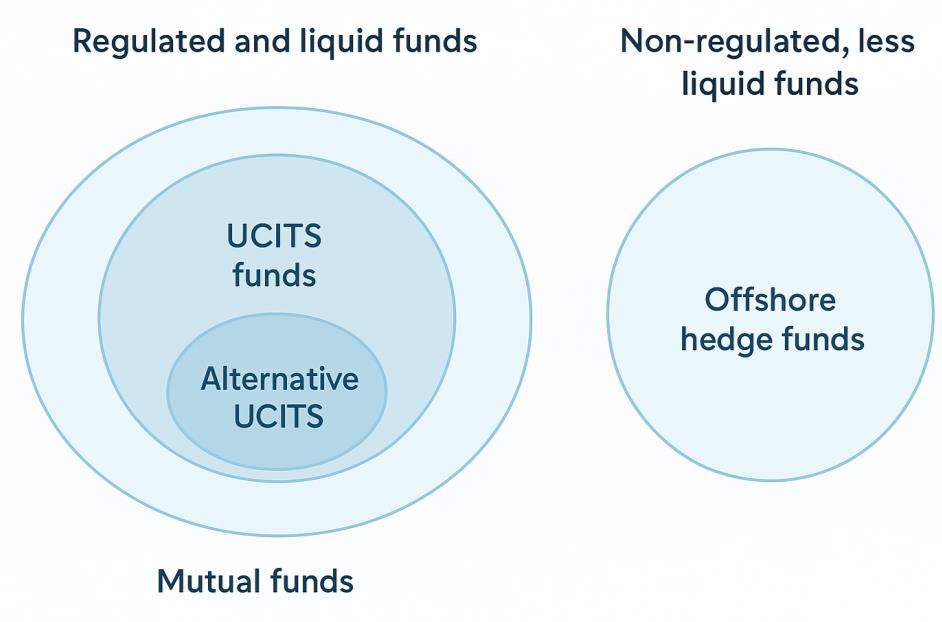
Less regulated than traditional funds, hedge funds are typically available in offshore or 'UCITS' format. Offshore hedge funds are private investment partnerships that only accept professional, institutional, accredited, or qualified investors.
Advantages / disadvantages
Advantages
- Participation in markets and instruments not available to traditional financial instruments
- Participation in market environments where traditional instruments offer few opportunities
- Professional management with performance incentives
- Reduced portfolio volatility
- Opportunities for high returns at the cost of using high-risk investment instruments
Disadvantages
- Possible liquidity constraints resulting in longer and in some case significantly longer time to redeem the investment
- Minimum investment period (possible lock-up period)
- Usually not listed/illiquid participation
- Price uncertainty: limited regulations concerning the calculation and publication of net asset value
- Only accessible for professional/institutional/qualified investors
- Largely unregulated
- Lack of control: the fund manager has absolute trading authority.
Important risks to consider
Lack of control/ transparency
As they are less regulated, hedge funds may not need to disclose their portfolio composition and risks. Investors therefore have less information to help them judge the risks. .
Currency risks
The investor may be exposed to currency risk because the product or underlying of the product is denominated in currencies other than that of the country in which the investor is resident.
Market risks
Hedge funds invest in a variety of instruments and can make use of derivatives and advanced techniques such as short sales and leverage. Therefore, the degree of risk is driven by the investment strategy and the risk/return profile of the fund.
Operational risks/fraud
As a result of the lack of transparency, operational risks and fraud risks are greater than with traditional funds. The success of the fund also depends on the quality of the hedge fund management.
Liquidity risks
Redemption of shares may only be possible with advance notice and at specified dates (e.g. quarterly, semi-annually, and annually). Minimum investments and long periods may apply. In addition, hedge funds may have so-called "gating" provisions in place restricting the amount that an individual investor or investors in aggregate can redeem on specified redemption dates. Such gating provisions can substantially increase the time until investors are able to fully redeem their investment. Hedge funds are not necessarily listed and traded at the secondary market.
Legal and regulatory risks
The legal and taxation of the hedge fund investment is subject to local regulations. In many jurisdictions, offshore funds may not be offered at all or only to a restricted class of investors. Conditions concerning the qualifications of the investor usually apply.
What to expect from non-traditional funds
| Investment horizon | Income expectation | Market expectation |
|---|---|---|
| Long term | Capital gain | Independent · Sideways · High volatility |
A closer look at hedge funds
Hedge fund strategies (1/2)
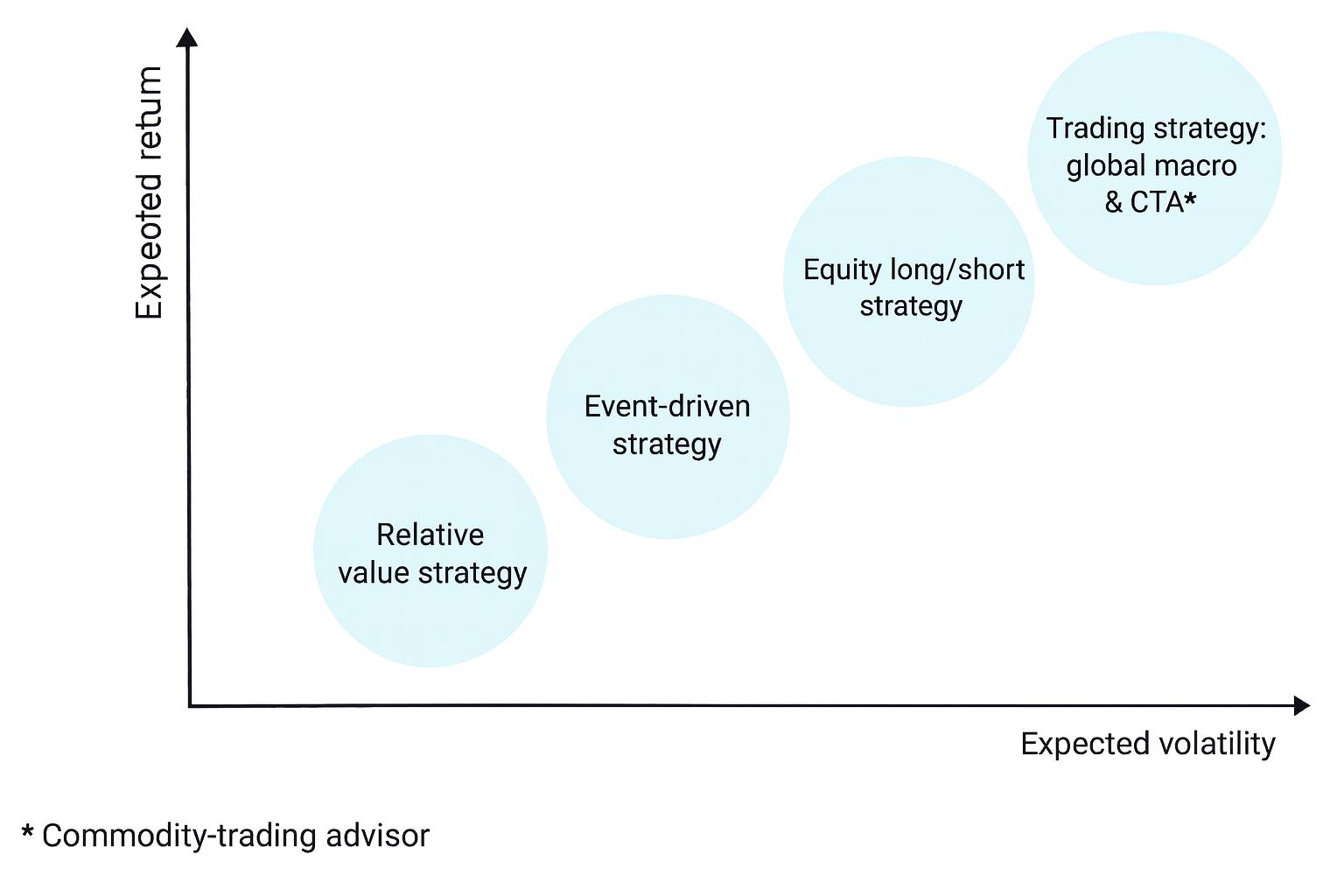
Having an absolute return goal and flexibility to use advanced investment strategies is not tantamount to maximising profits regardless of risks.
The actual risks that a hedge fund takes vary widely and depend on the strategy the fund uses and the financial instruments/techniques that are applied within that strategy.
Hedge fund strategies (2/2)
Important hedge fund strategies
| Strategy | Explanation | Types | Description |
|---|---|---|---|
| Relative value | Profits are realised based on price differences between markets, and not on specific market expectations themselves. | Convertible arbitrage | Takes advantage of price differences between an implicit option and the underlying value. |
| Fixed income arbitrage | Takes advantage of price differences between fixed income instruments. | ||
| Capital structure arbitrage | Takes advantage of pricing mismatches between assets and foreign capital of a company. | ||
| Equity market neutral | Uses differences in stock prices by balancing long and short positions in market sectors. | ||
| Event-driven | Profits are realised by stock price fluctuations caused by single events in a company’s life cycle. | Merger arbitrage | Takeover or merger of companies. |
| Distressed securities | Companies in difficult situations. | ||
| Special situations | Special situations such as spin-offs or buy-outs. | ||
| Equity long/short | The fund invests according to its expectations regarding the future development of stock prices. This strategy is therefore a directional approach. | Equity hedge | The equity portfolio is hedged using options/derivatives. |
| Equity non-hedge | Similar to common investment funds, but managers can make use of external financing (leverage). | ||
| Short selling | Incorporates an opportunity for the fund manager to make investments on falling market expectations. | ||
| Trading: Global macro | Investments based on the early detection of macroeconomic events such as over- or underestimation of exchange/interest rates. Fund managers invest in different markets, such as currencies and commodities, using a wide range of financial instruments (e.g. futures, options). The investment approach can be ‘discretionary’ (investment decision based on the discretion and expertise of the manager) or ‘quantitative’ (data processed with statistical models and/or technical analysis in order to identify mis-pricing and generate trades). | ||
| Trading: CTA | Commodity-trading advisors (CTA) trade exchange-traded future contracts on a variety of underlyings, including commodities, equities, and currencies as well as indices and interest rates. CTA trading is typically systematic, based on computer models that seek to capture future price movements in global futures markets across a wide variety of instruments and time horizons. |
Access to hedge funds
Different ways of investing in hedge funds
| Access | Description |
|---|---|
| Direct investment offshore | Professional, institutional, accredited, or qualified investors can invest directly in the estate of offshore funds. The legal status of offshore funds may have an impact on the taxation of the investment. |
| Direct investment in locally registered hedge fund | If registered and approved by the local regulator, such funds can be sold to the public (e.g. UCITS). |
| Investment in an exchange traded fund company | Some hedge funds are listed on a securities exchange. This can result in a larger correlation of the fund's stock market. Exchange-traded hedge funds may be sold at a premium/discount. |
| Fund-of-hedge-funds | Invests in selected hedge funds. Besides disadvantages of additional costs and less transparency, fund-of-funds can have advantages such as lower minimum amounts, better diversification, and access to funds that are closed to new investors. |
| Access funds/managed accounts | Dedicated minimum investments fees. Access to closed managers. Standardized costs at access fund level. |
Differences between mutual funds and hedge funds
Hedge funds differ in many aspects from mutual funds, and not just in that hedge funds can only raise funds from professional, institutional, accredited, or qualified investors. The table below lists further important differences.
| Mutual funds | Hedge funds |
|---|---|
| Market-based strategy: returns measured against a benchmark | Absolute return strategy |
| Regulated: less flexibility in terms of strategies, instruments, and markets as a result of increased investor protection | Less regulated: high flexibility in terms of risks taken and strategies chosen |
| Long positions only | Long and short positions possible |
| No leverage | Can use leverage |
| Management fees | Performance fees in addition to management fees |
A key feature of hedge funds is that they concentrate on generating returns independently of the market environment. They are thus an alternative investment and have a low correlation with traditional investment categories.
Consequently, an important reason for investing in hedge funds is portfolio diversification.
Alternative UCITS funds
Regulated funds that are benchmark-agnostic
The term 'UCITS' refers to undertakings for collective investment in transferable securities that are authorised under the European UCITS Directive. The UCITS regime used to focus on traditional funds such as equity, bonds, and mixed asset funds, but may also be used to create some alternative types of funds.
Alternative UCITS are simply UCITS that take advantage of certain investment techniques permitted by the UCITS Directive. Those techniques enable UCITS to pursue strategies that were previously more common in the hedge fund sector.
Performance objectives of alternative UCITS are less driven by traditional market index benchmarks. Instead, they tend to be more benchmark-agnostic and use financial derivative instruments to have both long and short exposures. They may also use a certain degree of leverage.
The use of such techniques and instruments to create alternative UCITS has been permitted since the implementation of UCITS III at the beginning of 2003.
Alternative UCITS funds — Building blocks
The 'building blocks' of UCITS funds can be broken down as follows.
Structural principles
- Ability to redeem at the net asset value on demand
- Segregation of assets
- Valuation occurs any time units are issued or redeemed (usually daily or weekly liquidity vs monthly or quarterly for offshore hedge funds)
- Separation of functions to limit conflicts/abuse
Investment rules
- List of eligible assets
- Risk diversification
- No direct borrowing/shorting (only through derivatives)
- No direct investment into commodities or real estate (only through derivatives)
- Limit to global exposure or limit to value at risk
UCITS passport
- European-Union-wide marketing once authorised in home country
- Notification procedure
- Very limited host country involvement
Investing in hedge funds — some important considerations
Important to know before investing in hedge funds
| Maximum gain | Maximum loss | Profit/loss |
|---|---|---|
| There are no limits or preconditions. Fund managers aim to maximise absolute returns. | Total loss of capital invested. Depending on the legal aspects, there may be a theoretical possibility of unlimited loss. | Possible profits cannot be predicted in terms of volume and cash flow time, and depends on the fund's performance. |
- Profit trends by absolute return objectives not benchmarking.
- Long-term investment horizon; minimum investment period and sometimes illiquidity.
- Profit/loss risk depends on the investment strategy.
- More independent of the movements of indices or other investments strategies, hedge funds are less correlated to stock and bond markets.
Three golden rules for hedge funds investing
1 . Invest through a portfolio approach
'Don't put all your eggs in one basket.' Diversify across different strategies and managers, as opportunity sets and manager skills go through cycles. Multi-strategy and multi-portfolio manager funds (core) should generally be larger sized than single-strategy and single-portfolio manager funds (satellite).
2 . Have a realistic risk/return expectation
'There is no such thing as a free lunch.' While hedge funds have the toolbox to deliver attractive returns that are less correlated with traditional asset classes, there is often a trade-off. This trade-off is typically lower participation in bull markets, larger risk from manager mistakes, and/or tail risk due to leverage.
3 . Understand the liquidity terms
Hedge funds (especially offshore) have unique liquidity terms. Next to the less frequent redemption options, there is typically a notice period that needs to be given prior to a redemption. Make sure you understand (if applicable) the implications of investor-level gates, fund-level gates, lock-ups, and audit holdbacks.
Important legal information
Legal entity
U Wealth SA – 8C avenue de Champel, 1206 Genève, Suisse. Supervised by FINMA (Swiss Financial Market Supervisory Authority).
Educational and Informational Disclaimer
Educational and Informational Disclaimer: This content is provided for informational and educational purposes only. It does not constitute marketing material, nor is it the result of independent financial/investment research. It has not been prepared in accordance with the legal requirements designed to promote the independence of financial research and is not subject to any prohibition on dealing ahead of the dissemination of such research. The content has been prepared by U Wealth SA, which is authorised and regulated by FINMA (Swiss Financial Market Supervisory Authority). The information may be updated irregularly or in response to significant developments.
Informational Purposes Only
Informational Purposes Only: All information and opinions were valid at the time of writing and are subject to change without notice. This document is provided for informational purposes only and does not constitute legal, tax, accounting or investment advice, nor does it constitute an offer or invitation to buy or sell any financial instrument. Opinions expressed herein reflect the current views of the authors but not necessarily those of U Wealth SA as a whole. While the information is believed to be accurate and sourced from reliable providers, U Wealth SA makes no warranty as to its accuracy, completeness, or timeliness. U Wealth SA accepts no liability, to the extent permitted by law, for any direct or indirect damages or losses arising from the use of this material or any decisions taken based on it.
Suitability & Professional Advice
Suitability & Professional Advice: Investments mentioned may not be suitable for all investors. Each investor should consider the suitability of an investment to their personal circumstances and objectives and consult their professional advisor before making any financial decision. This content does not constitute a personal recommendation and does not take into account your personal investment profile or financial situation.
Sustainability / ESG
Sustainability / ESG: This material does not necessarily adhere to ESG regulations or standards that may apply in other jurisdictions. For details on ESG criteria and any potential impact on financial return or investment eligibility, please contact U Wealth directly.
General Risks
General Risks: The value of and income from investments may rise or fall, and investors may not recover the amount invested. Financial instruments may be exposed to various risks, including but not limited to market, credit, political, and currency risks. Past performance and simulated returns are not reliable indicators of future performance. Structured products mentioned do not represent collective investment schemes under Swiss law and are not supervised by FINMA as such. Investors do not benefit from the specific protections provided by the Swiss Federal Act on Collective Investment Schemes.
Third-Party Data
Third-Party Data: Some information may originate from third-party providers such as credit rating agencies, financial data sources, or ESG data platforms. U Wealth SA does not guarantee the accuracy or completeness of this data and declines any liability related to its use.
Restricted Distribution
Restricted Distribution: This content is intended solely for recipients located in Switzerland and is not directed to any person or entity in any jurisdiction where its distribution would be contrary to local laws or regulations. This document may not be reproduced or distributed without prior written consent from U Wealth SA.
United States
UNITED STATES: NEITHER THIS CONTENT NOR ANY COPY THEREOF MAY BE SENT, TAKEN INTO OR DISTRIBUTED IN THE UNITED STATES OR TO ANY US PERSON. © U Wealth, 2025
Contact information
contact@uwealth.ch | +41 (0)22 545 51 40